
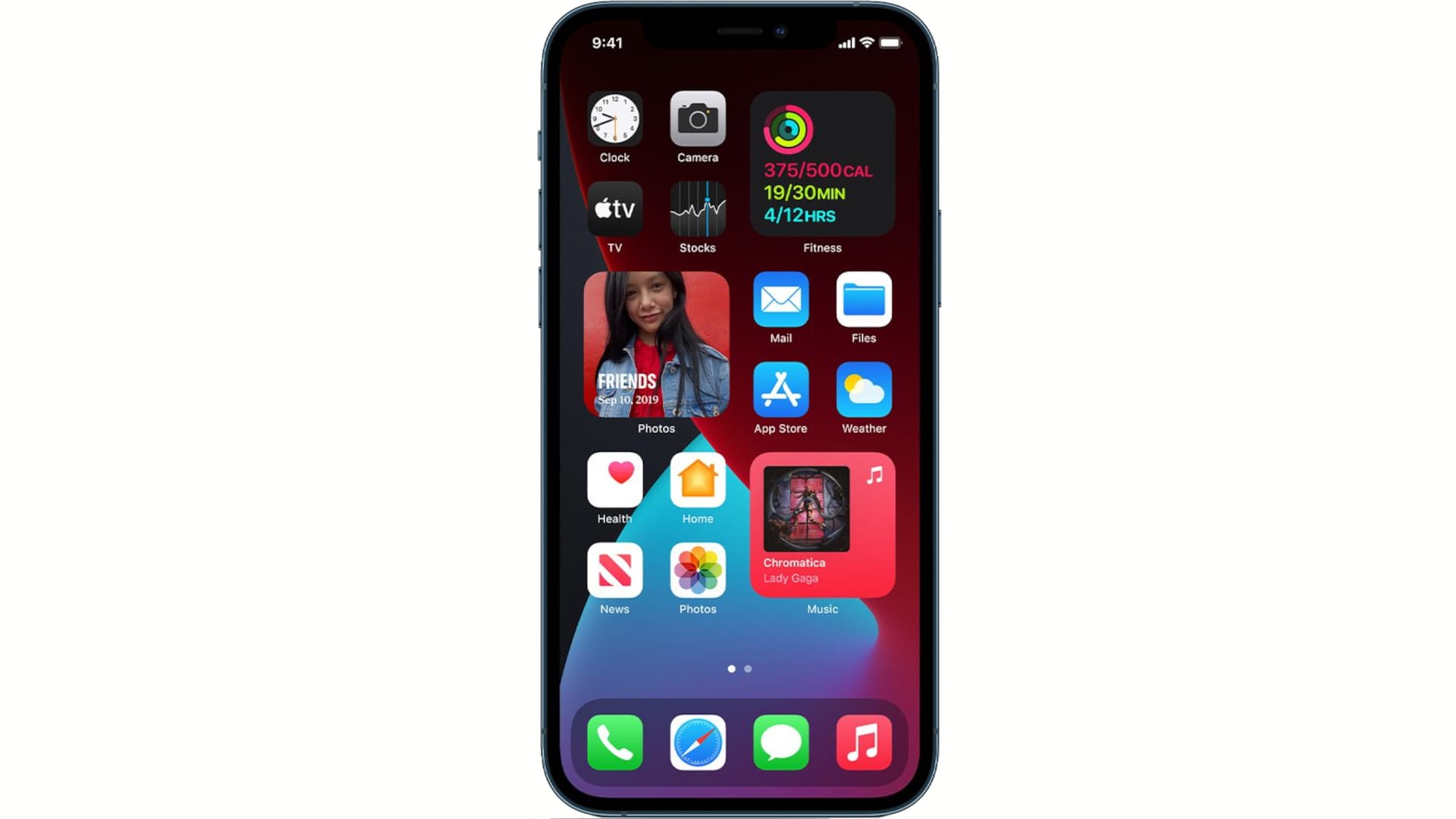
In this article, I give you my Apple iPhone 12 Pro review with specs included. It’s that time of year again when Apple launches iPhones, and we have the iPhone 12 Pro here. Also, I did a review of the iPhone 12 (not Pro), and the Max versions.
This is new for Apple insofar as the old Pro was 5.8 inches, and then the Max was significantly larger at 6.5 inches; the newer one is going to be 6.7 inches. So you kind of had a big size rang,e rig, ht with the regular iPhone (not Pro) sitting in the middle at 6.1 inches, which I always thought was a really nice size.
You’re getting big, but you’re not getting so big that you’re buying your pants to fit your phone and having a very heavy phone slamming into you thanks to that, well, premium stainless steel thing that Apple loves to do. So, 6.1 inches, I think this is a sweet spot for a lot of people; I know it is for me.
So, what’s new here? Obviously, the design. Besides the size changes, we have the flat-sided look. Whether you go with the 12 or the 12 Pro, you’re going to get that design. In fact, the 12 and the 12 Pro take the same cases. Everything is the same in terms of the dimensions, where the buttons are, and all that sort of thing.
I like this straight-sided look because it’s easier to hold on to. It’s not so much that slippery bar of sub sort of phenomenon. I have a feeling that other manufacturers will probably copy it, as they tend to do with Apple, including when they were all copying the notch. Yes, unfortunately, the notch is not new; it’s still here, and that’s for the TrueDepth front camera on board, and that 3D, very secure kind of camera takes up a lot of room still.
So, we still have a notch here. The display, however, is a little bit higher resolution. It’s still that OLED retina XDR, whatever Apple likes to call it in terms of marketing terms. It’s a lovely display; it’s low reflectance. I find this one the easiest to see outdoors, and where there is a lot of super bright sunshine, you really get to experience that out.
800 nits, 1200 nits on auto max brightness, which we see a lot of phones do these days. They don’t let you drive it at the full 1200 nits all the time because you would kill your battery life, but it brightens up when you go outdoors.
Also new is the MagSafe charger thingy on the back. It’s a magnetic ring; basically, it’s a low-powered magnet, so they don’t warn you about putting your phone near your chest and your pacemaker or your wall and all that sort of thing. But they do warn you if you combine the phone with a MagSafe case that you keep your credit cards and other mag strips away from it, for those who still have mag strips that you use on your credit cards.
And, at first, I thought this was going to be the most brilliant selling point for the phone, something so simple. And that’s what Apple is good at: they don’t come out with a lot of wild new technologies; they take something that existed and put it to use in a way that’s something a lot of people want. And it might still be that the MagSafe charger is very compact compared to other wireless chargers; that’s nice enough, but the fact that it magnetically clips on is so convenient.
Because with wireless charging, you know you’re always jiggling your phone around, sliding it to find the sweet spot; maybe you bump it, you just realize, oh, it was not on the wireless charger properly anymore, and you didn’t get the charge that you needed- that sort of stuff. But beyond that, it’s things like stands, car mounts, tripods, all those sorts of things; suddenly, with a whole ecosystem probably that will come out of mag safe accessories becomes as easy as just snapping your phone on.
So, we tested this with several different cases, and I can tell you leather cases that are not MagSafe cases, which means they also have a little magnetic ring embedded inside of them; no magnetism happens there. You can still charge with them just fine, but no magnetism happens. With the TPU and the plastic cases that we’ve tested, we have a total case, which is a clear case; that onechargese just fi,ne and there’s still a little bit of magnetism.
We tried the Pitaka case, which is a very thin, kind of aramid carbon-fiberdesign case; there’s still a little magnetism, and that works just fine. If you go for something super thick, probably you won’t get much magnetic strength anymore. You don’t need the magnets to charge; the whole point of the MagSafe also is that’s a 15-watt charger, whereas other qi charges charge an iPhone at 7.5 watts. You’ll only get 15-watt charging with these new iPhone 12 models, not the iPhone 11 or older, so there’s that.
FROM HERE>>>
And I found that using even the existing 18-watt charger, which is what Apple used to ship, including with the 11-11 Pro family of phones, works the same as the new 20-watt charger. Which, by the way, is maddeningly identical-looking except for it has a little 20-watt in light gray on gray. Thanks to apple make it hard to read so you can tell which is which.
But I mean, the two odd differences for a 15-watt charger not so much. Speaking of that, no charger in the box anymore. No AirPods wired earpods anymore. So the box is thinner. Apple says this is great environmentally and reduces shipping cargo space and all that sort of thing; I don’t know. It’s probably really about keeping the cost of the phone down and keeping their margins up. That’s what I think.
Anyway, that 20-wattchargere that I was talking about didn’t ship with any iPhone, so nobody actually has one. If you’re dying to have the latest greatest 20-watt charger to maximally wire to charge your iPhone at 20 watts, you’re gonna have to pony up 19 bucks for that charger too.
While we’re still on that topic, the MagSafe charger is 39 bucks, which is pretty inexpensive relative to other name-brand and wireless chargers, say from Samsung or something like that. But Samsung gives you the charger brick in the box. Apple still doesn’t do that. Yeah, and throw another 19 bucks on, so it’s more like 58 for the pairing.
And also the MagSafe charger has a USB-C cable permanently attached to the charger. So if you find that it’s too short, because, you know, Apple never gives you long cords on things, it will. Back to the phone itself. It has the A14 Bionic CPU, as ever,r silly fast.
Apple does find uses for it, like computational photography and augmented reality and stuff like that, but future-proofing, believe me, yes, it’s very fast. And typically Apple does beat out the higher-end Snapdragons and Android land, but you know all of our phones are really faster than we need. So whatever, that’s nice. We have new ceramicized glass on the front face only, not on the back.
So if you watch drop tests,s keep that in m,ind or scrateststest there will be a difference. And Apple says, well, it’s harder to crack it. Which is nice, and so far in the drop tests and scratch tests I’ve seen it does seem to be a bit more durable. But we’re still talking about a phone that is glass front and back.
Handle your phone accordingly. I.e probably use a case. It’s a little bit lighter; get ready for Halloween, folks. 6.66 ounces, which is 189 grams. And I do appreciate that again because Apple’s phones tend to be pretty heavy compared to the competition, thanks to the stainless steel thing going on. It’s a little bit thinner than the last generation at 7.4 millimeters versus 8.1.
Again, that’s a welcome change, and it’s probably a good idea because when you have straight sides it you know it doesn’t sit in the hand quite as comfortably for some people. If it’s a stretch for your hand,d for example. I have really huge h;ands a 6.1-inch iPhone 8 stretches in my ha, nd so it’s quite comfy. But the idea there is: the less width, the more hand comfort you gett.
Probably that will be even more important for the Pro Max, which is going to be one big phone. The cameras on this have incremental improvements in terms of the specs and most of the shooting capabilities. Something new, though, is the ability to shoot in Dolby Vision HDR 4 K video. Which is really coo,l anI i think six months from now is going to be even cooler.
Why? Because it’s the latest version of the Dolby Vision standard or codec. And right now not many TVs support that. If you play it on your iPhone, your iPhone does support that, then you’ll see more vibrant colors;s it’s going to look really nice.
And it does look really nice. But as you start to try to put that on your TVs or your monitors and all that sort of thing,g it’ll default to a standard definition sort of definition of color. Or sometimes just look a little bit wonky, right. Now, so yeah, I’m sure given Apple’s millions of iPhones that they ship, we’re going to see all TVs get updated pretty soon.
For those who want to consume your beautiful videos on the screen. Other than that, the apertures get a little bit faster on the lenses. And the big thing for the camera here is the ultra-wide-angle camera gets night mode now. So before we didn’t have that. And we’ll, it’s prettobvious, us right. Sometimes you want to use the ultra-wide, and it was dead in the water at night.
So we’re competitive with Samsung’s offerings, and the Pixel and all that sort of thing would be on the shoot. Good night mode photos in an ultraviolet way. In terms of the cameras, you’ve got 2x optical zoom for the telephoto and 2x optical zoom for the wide-angle lens. The Pro Max will give you two and a half x optical zoom for the telephoto lens.
But the more interesting thing with that one is it has a bigger main sensor size, which usually means more depth of field, a little bit more natural bokeh, and even better low-light handling. So it’ll be interesting to see that to see how much of a difference that makes. It’s still 12 megapixels, and just like these are all 12-megapixel front and rear.
By the way, the front camera can shoot Dolby Vision HDR as well. But I think it’s good that they also went with a super high megapixel count and complicated. Because we’ve seen with the Samsung S20 Ultra and the Note 20 Ultra that it can be challenging for everyday photographer types. Not the enthusiasts already know how to use their apertures and their lenses and all that sort of thing.
Getting that shallow depth of field under control to have your subject be fully in focus. I have a feeling that Apple’s probably going to do a good job of keeping it simple and keeping it sharp; we’ll find out. As usual, Apple increases the base storage amounts every year.
So you paid the same price, which also, by the way, 9.99 is starting to seem attractive now that we’re seeing phones twelve hundred dollars, fourteen hundred dollars in competition from Samsung, oneplus prices are even going up, but anyway. This starts at 128 gigs of storage. As always, if you want to go up, it’s 100 per storage increment, and the up increments are still 256 and 512 gigs. Also, obviously, we have the 5g.
This is the year of 5 G, so this in the united states supports low mid-band and millimeter wave, and in the United States, because we have millimeter wave, particularly Verizon’s big on that. That’s the super duper fast but very, very short range kind of 5g. We have a little antenna window on the side. So 5g right now, I do find it gets a little bit better signal strength and coverage, not much better data speeds.
How it’s going to affect battery life. Well, I haven’t really seen it impacting the iPhone. Now with the iPhone, what they’re doing is they’re switching between 4g and 5g depending on what you’re doing. If you’re streaming a video, you’re probably going to want to use 5g because that requires more bandwidth. If you’re just staring at web pages, it’s going to use 4 G.
That’s the idea behind it anyway, to help save battery life. So we only have low and mid band 5g here, mostly low band. Doesn’t really affect battery life much, as I can tell. But if you are in millimeter-wave coverage, well, lucky you. You’ll get psycho fast data speeds that you probably don’t even need on a phone, and that probably will create more heat and reduce battery life too.
So it gets to be a little more challenging talking about battery life. Battery capacity is actually slightly down from the 11 series. So if you’re i don’t think a lot of people go every year anymore upgrading their iPhones, but if you did, that’s one thing you might feel like your battery life isn’t quite as good as last year’s model. If you’re coming from an iPhone 10 or older, you’re probably going to think the battery life on this is rocket.
Unless you’re in a millimeter-wave coverage area. You always have the option of just going with 4g on the phone if you do find that it’s killing your battery life. So what about the iPhone 12 versus the 12 Pro? There used to be a bigger divide in terms of price and features, right? The regular non-pro model had an LCD; it didn’t have an OLED display.
There was a difference in the screen size and all that sort of thing. Now you’ve got the identical body design, only aluminum on the 12. And again we’ll be reviewing the 12. You get an OLED display on that one too. Huh, you get the same C; PU you get the MagSafe well. What don’tyou?. You don’t get three cameras; you get two. You lose the telephoto lens.
Uh, you lose some of the higher-end photography options, probably just because they wanted to do that, not because of computational reasons running the same CPU. You get less RAM: four gigs on the 12 versus six gigs on the 12 Pro. But you do get a lighter aluminum phone, and you get brighter colors on the regular line of phones.
They always go these subdued colors with the Pro line, and this year it’s specific blue that we have, which is very pretty. With the regular 12 series, you get some more bold colors, and you get a glossy back on the phone. Now, to make a note about price between these two. In the united states is 839 for the 12, not Pro, and 999 for the 12 Pro. But the Not Pro starts at 64 gigs of storage.
So if you want to move up to 128 gigs of storage for parity, that’s 879. You’re only talking a 120 difference, which I think kind of upsells people to the Pro. You get the stainless steel, you get the telephoto camera, you get more RAM, you get the idea. For Face ID, it works pretty much the same as the previous generation, which means it’ll be a little bit quicker than the iPhone 10 if you’re upgrading from the iPhone 10.
Also, we still have theIP688 water resistance. So let’s talk a little bit about the iPhone and pricing and competition. This phone is 999, which used to seem offensive a couple of years ago when it was the first phone to be so expensive, and now it seemslike, we’ l,ge,e uh SamGalaxy S20 Plus plus is 11.99, 1200 list price. We’ve got S20 Ultras and Note 20 Ultras going around 1400, and well, then the folding phones that cost even more.
So I can’t say now that Apple is like the most expensive obviously out there. But clearly one thing they’re not doing is doing anything different, are they? This is still an iPhone. It’s a lot of nice evolutionary things, just a nice new design; we get the MagSafe ecosystem, but it’s still pretty much the same iPhone you knew, and if you’re an iPhone user, you love it. This is not a galaxy z fold to,o exact, ly is it? Of course, you could buy two iPhone 12 Pros for the cost of one Z Fold, too, couldn’t you?
But there’s no shock at all. I know some people are migrating over to folding phones because they feel like there’s something new happening there that Apple still really isn’t doing. Likewise, there’s the Galaxy Z-Flip and Z-Flip 5 G as well, around fourteen hundred dollars if you like the idea of a foldable fashion phone going on.
And then we have things like Samsung always pushing the envelope in terms of not necessarily revolutionary things. I mean, they’re doing things like space zoom with the camera, which is kind of neat and all that,t but they’re very good at taking a phone like the S20 Plus and making it feel smaller than it is. So competition is a good thing.
So that’s the iPhone 12 Pro, as you can tell; I really like this new redesign. I think other people are going to be copying it. I like the size of this at 6.1 inches; it’s a good-sized screen without being a humongous surfboard in your pocket. But they will be making that surfboard model soon in November for you in case you really want the biggest one.
And we’ve g5 GB 5g on board for future-proofing. Other than that, always with an iPhone, fantastic video quality. Very good photography in general. We’ve got a lovely display that works quite well in bright light; we have a very good night mode; we’ve got pretty much everything you want from an iPhone and in a pretty stainless steel build.
Apple iPhone 12 Pro
-
Performance - 96%96%
-
Price - 95%95%
-
Value - 96%96%