
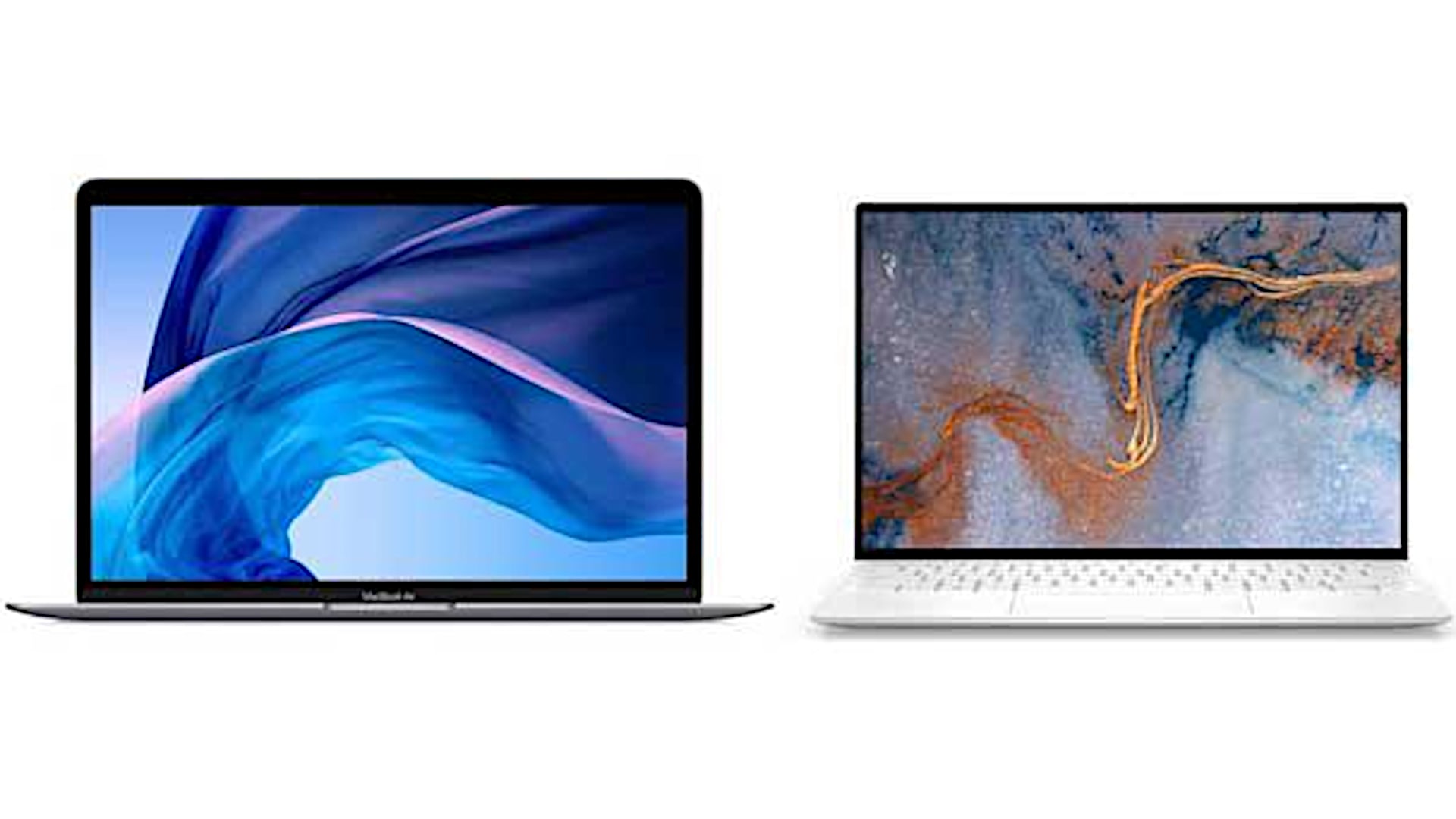
This article gives you my Apple MacBook Air vs DELL XPS 13 9300 (2020) comparison with specs included. Since you asked, this is the 2020 MacBook Air and the Dell XPS 13 9300, the 2020 Edition by popular request. Both Intel ice-like tenth generation CPUs 13,3 to 13,4-inch displays with a 16: 10 aspect ratio.
So flat out, this is not a completely fair comparison. Why is that? Because the MacBook Air, as ever, runs on Intel’s lower-power 8- to 9-watt CPUs- what was called the Core M and then the Y series, and now Intel doesn’t quite even give it a name anymore and the XPS 13 is your typical ultrabook with a 15 watt CPU only a little better because they basically over wanted to that 25-watt point so yeah keep this in mind.
In terms of pure CPU benchmarks and tests like that, the Dells go running circles around the Air. The 13-inch MacBook Pro in this respect is the more direct competitor to the Dell, which Apple hasn’t refreshed yet with Intel’s 10th gen. When they do, we can revisit that comparison too.
Also, the pricing is different. The XPS 13 on launches and gotten more expensive than it used to be, so it starts at $1250. It gets you a Core i5 with eight gigs of RAM and a256-gigg NVMe SSD and Intel UHD G1 graphics. The MacBook Air starts at $999, but that’s what theCoree i3 making surrounds a 256-gig NVMe SSD and Intel Iris Plus graphics with better graphics, so we’re using a little bit more apples-to-apples, no pun intended, to sort of comparison there.
And we’re using the $1299 model of the MacBook Air, which has a Core i5 with eight gigs of RAM and a 51GBer SSD. Across the board, you’re gonna get intel iris + graph is gonna get faster graphics with the MacBook Air, whereas with the Dell you have to look at their more expensive models. They bundled the Intel Iris Plus graphics with the Core i7 config; typically with a 4k display, you’re looking at around $1,800 pretty pricey for an ultrabook.
In terms of the size of the footprint, the Dell XPS 13 is always one of the most compact things. So that’s almost no bezel design, even though it’s 13.4 inches versus the MacBookAir’ss 13.3; it’s actually got the smaller footprint in terms of thickness; they’re almost the same. MacBook Air is gonna be a little thinner at the front, but overall they’re within one millimeter of each other.
At the back, which is the thickest point, despite the fact the MacBook Air is named Air, it’s actually a little heavier 1.2 9 kilograms versus 1.2 kilograms for the Dell.
For display options, there’s only one display option: it’s the Retina 2K-equivalent display for the MacBook Air, and it’s a very pleasing display with full sRGB coverage, so it sits in between the two Dell options. With Dell, you have full HD, or you have the 4k, a little bit more in one dimension than 4k because in sixteen by ten aspect ratio, but basically.
So, with the Dell, the full HD display is available in a matte non-touch, so if you like matte displays, right away there’s a winner for you. It’s also available on the glossy touch screen, which is the one that we happen to have, and then there’s that 4k option; those are all 500 nits displays according to Dell.
Now, with the MacBook Air, it’s around 315 nits, which is pretty bright for your average indoor use, but for those who are working a lot outdoors,t keep in mind 500 nits is certainly more useful. Or, again, there’s the 13-inch MacBook Pro, which has a brighter still display and a wider color ga,mut which you’ll see on the 4k display. For the Dell, the 4 K display is a somewhat wider color gamut than the full HD display.
Now, Apple does have a low reflectance display, so as glossy displays go, it’s not that bad. Oh,h and there’s touch. Obviously, Mac OS doesn’t support touch; there’s no touch screen there. You gotta go look at an iPad if you want to touch it.
I in the max favorite, it’s a very nice-looking display. And one thing I can say that really is excellent about Mac OS is system-wide color management, so your colors don’t go from garish to more appropriate and all that sort of thing randomly depending on what program you’re using. And, also, their system-wide handling of display scaling, so if you get the 4k display on the Dell, you might find some apps that still have dialog boxes with really tiny tex,t and Photosh, op since I’m still troubled, struggles to get all the tools in the UI to be a viewable size; you get the idea. And, with a Mac, usually not a problem.
Connectivity is quite similar. Both of them have two USB-C slash Thunderbolt 3 ports, full four-lane 40 gigabits per second at that. Both have headphone jack,s awell asin a microSD card slot, which is nice to have. Dell puts one port on each side, which might be a little bit more convenient. nt Apple puts them both on the same side, and one is used for charging.
When it comes to two keyboards, Apple has switched over to the Magic Keyboard for the 2020 refresh; thank God for the traditional scissor key, one millimeter of key travel. The Dell is also pretty low-key travel; they feel very similar. On the other hand, ing this one is a toss-up. And they’re both backlit.
And white for the trackpad, you have the usual large and wonderful trackpad with Mac OS and all that sort of thing, the gestures, yeah. Dell is a precision trackpad, which is a good thing, but I still don’t find it quite as good as the Mac. That’s not a surprise, is it though.
Dell has Wi-Fi 6; the Mac still has Wi-Fi 5. That’s not an issue today for most people, but if you’re gonna keep this machine in three years, two million might wish you had this slightly faster Wi-Fi standard going on.
When it comes to upgradeability, neither of these is really great. At least with the Dell, you can replace the SSD. It’s a standard M. 2 SSD; they both use NVMe fast SSDs, but the max is soldered on. The RAM is soldered on, and the Wi-Fi card is soldered on, so you’re not looking at upgradable machines here. But at least you can swap and swap the drive on the dome. You can get either of these with up to 2 terabytes of storage. And for RAM, they both max out at 16 gigs, and again that’s soldered on. And they both use 373733egahertz fast, low-powerDDR4 RAMm.
When it comes to cooling, you know this isn’t gonna be a surprise because the Dell has a higher wattage, which means a higher heat CPU. It’s the one that’s gonna run hotter, and you’ll hear the fan more often on it.
When it comes to benchmarks, as I said, it’s just not a fair comparison because you have two different classes of CPUs here. They know Mac, Mac does fight back though with having better graphics performance and, for, if you’re comparing it to the base model Dells of Intel u HD graphics instead of Intel Iris Plus graphics.
For speakers, here’s a little surprise: who’s that max typically really good speakers, so the speakers are pretty good, and I would give it the edge for bass, but I like the clarity and the spatial separation better on the XPS 13. They’re both really pretty good though.
For very small laptops, battery capacity is really close on this: 49.9Whh with a max of only 50 watt-hours versus 52 watt-hours. The Dell isindependent oft which display you opted for with the Dell, though the Full HD is obviously gonna use a lot less power. 4K displays really suck up the power; we’ve seen it from many Windows laptop reviews. So, the Mac is really strong on battery life; not a surprise they’re very efficient. The CPU they’re in and the operating system do a good job too.
So, the Mac, it’s pretty easy to get nine hours of actual use on a charge. With the Dell, it’s gonna vary you could do nine, 10 maybe, even 11 hours on that base model. We could also stretch more with our Mac, depending on your power settings and all that. But the 4k display is gonna drop that by a couple of hours at least.
They both come with compact chargers, but the Max is much more compact, again, because it uses a lower walower-wattagedoesn’t need such a big charger, but I wouldn’t call the Dell a burden to carry.
Lastly, there’s the operating system difference. So, that’s always the thing where a Windows laptop might beat a Mac laptop on some of the specifications and all that sort of thing; it also depends on which operating system you prefer.
I like them both an awful lot. I do like some things about the Mac, particularly the color management, display scaling, and the stability. You don’t run into driver issues so much, and some people are already complaining about their Dell Real Tech Audio Driver problems uninstall and reinstall not that it’s a problem machine by any means, but that still happens with Windows and less with the Mac. So, if your tolerance for those things is not really high, that might push you towards the MAC.
So, there you have it: the Dell XPS 13 90 300 versus the 2020 MacBook Air, and as I said, it’s not really exactly a fair comparison by price and buying the kind of CPU inside, but hopefully you have an idea now which one might be better for you, and then there’s a 13-inch MacBook Pro.