
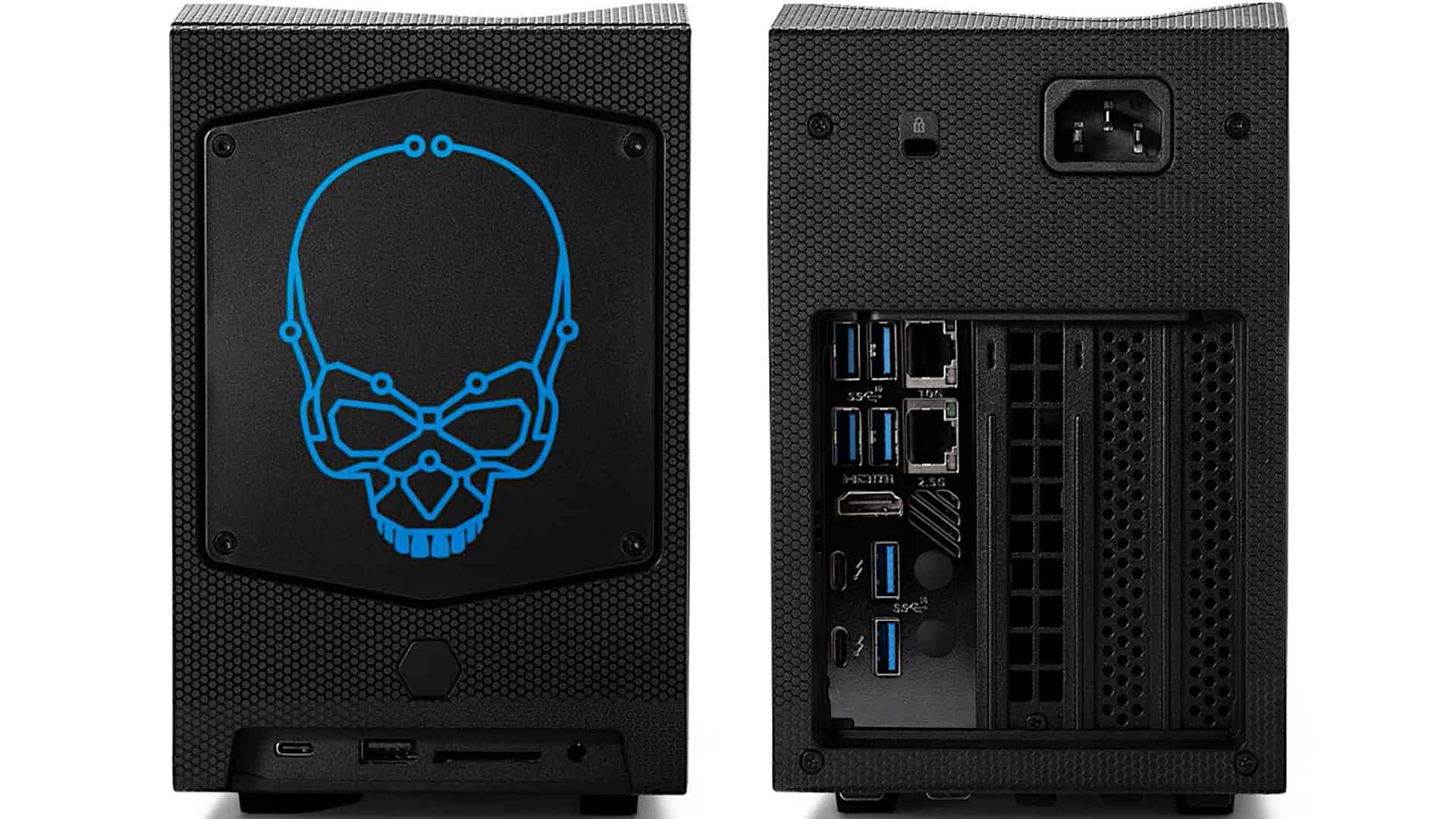
If you thought cramming serious computing power into a tiny box was impossible, Intel is here to prove you wrong. The NUC 12 Extreme is the latest iteration of Intel’s flagship small form factor machine, and it is genuinely jaw-dropping in terms of what it manages to fit into such a compact chassis. NUC stands for Next Unit of Computing, and Intel has built everything from palm-sized budget PCs all the way up to this kind of enthusiast-grade powerhouse aimed at gamers and content creators alike.
The chassis measures just 8 liters in volume, yet it accommodates a full-length 12-inch double-slot discrete GPU, a 650-watt 80 Plus Gold-rated internal power supply, and Intel’s 12th Generation Core processors. Our review unit came equipped with an Nvidia GeForce RTX 3080, which tells you exactly what performance tier this machine is playing in. RGB lighting lines both sides of the case, and an illuminated skull graces the front panel. You can customize the lighting to your preference, so even in a compact form factor, you still get the visual flair typically associated with a full-size gaming rig.
Design, Build Quality and Engineering
One of the most striking things about the NUC 12 Extreme is not just its size but the sheer quality of thought that went into building it. Anyone who has tinkered with budget or mid-range desktop towers from major brands will have encountered those familiar frustrations: a poorly placed fan, a flimsy motherboard tray, or standoffs that cause shorts when pressure is applied during cable management. None of that exists here.
Having spent years reviewing and working with PCs of all shapes and sizes, it is clear that Intel made very few compromises in the engineering of this chassis. Every component placement feels deliberate and purposeful. The cooling solution alone is worth highlighting: three large fans run along the top of the unit, one additional fan sits on the side, and a rear exhaust fan shroud handles hot air evacuation. Add to that the GPU’s own cooling system, and you have a remarkably well-ventilated machine despite its small footprint. Mesh grilles on multiple sides further assist with airflow, and the result is a machine that can breathe properly even under sustained load.
The RGB lighting can be fully controlled, and the overall aesthetic strikes a balance between gaming flair and professional restraint. It is unique in the desktop market, and there is genuinely nothing else quite like it.
The Compute Element: Inside the Machine
The NUC 12 Extreme uses what Intel calls a Compute Element, a concept the company has refined over several generations. In simple terms, it is a miniaturized motherboard housed within the larger chassis, featuring a socketed LGA 1700 processor, two DDR4 RAM slots, and two M.2 SSD slots, one of which supports PCIe Gen 4. This Compute Element slots into a PCIe slot on the system’s baseboard, which also provides additional expansion options.
The socketed processor is a notable feature. Unlike many compact PCs that solder the CPU directly to the board, the NUC 12 Extreme allows for CPU swaps, giving it an upgradeability path that most systems in this size bracket cannot offer. The 12th Gen Core i7 and Core i9 options are both 65-watt desktop-class chips rather than mobile variants, which means you are getting genuine desktop-grade processing performance in this compact shell.
For those who want to get inside and configure things themselves, the process requires some patience but is more manageable than it might initially appear. Removing the back panel involves four Phillips head screws, after which the side covers slide off freely. The top fan assembly can be detached by pressing two clearly marked pull points, revealing the Compute Element underneath. Importantly, you do not need to remove the entire Compute Element to access the RAM and SSD slots. Simply remove the adjacent fan shroud, undo two Phillips head screws on top of the Compute Element, and a hinged door opens to expose the internals. You can swap the processor, install RAM, or add storage drives from there. There is also a cleverly placed external SSD bay accessible through a panel on the bottom of the unit, so light storage upgrades do not require opening the machine at all.
This is not a beginner-level build. Working in tight spaces with small components demands some experience and careful handling. But for enthusiasts who enjoy the process, it is a genuinely satisfying system to work on, and the thoughtfulness of the layout makes the experience far less daunting than expected.
Gaming Performance and Thermal Behavior
With an RTX 3080 inside, the NUC 12 Extreme is a serious gaming machine, and testing across several major AAA titles confirmed that it delivers on that promise in most scenarios. Cyberpunk 2077 at ultra settings with ray tracing enabled at both 4K and 1440p produced strong frame rates with smooth frame times throughout. Assassin’s Creed Valhalla at 4K ran at a consistent 60 frames per second or better, which is all the game really demands. These are not trivial benchmarks, and the machine handled them with composure.
CPU temperatures during most gaming sessions hovered around 80 degrees Celsius, which is entirely acceptable. The GPU was well-ventilated thanks to its proximity to the mesh side panels, and thermals on the graphics side were not a concern. Things got more interesting with Far Cry 6, a title that is unusually CPU-intensive for a modern game. Under that load, CPU temperatures climbed into the low 90s Celsius, which prompted brief periods of power throttling from around 90 watts down to approximately 65 watts before ramping back up. Crucially, this thermal management did not translate into noticeable frame rate drops or gameplay disruption, so the impact on the experience was minimal.
Synthetic benchmarks like 3DMark pushed CPU temperatures as high as 99 degrees Celsius at times, but it is worth noting that artificial workloads tend to stress hardware far more aggressively than real-world use. Video editing in Adobe Premiere Pro also performed without issue. Productivity workloads and most gaming scenarios sit comfortably within the machine’s thermal envelope. The one caveat is for users who are simply not comfortable seeing high CPU temperatures under any circumstances: without the option for liquid cooling in a chassis this compact, the only meaningful thermal intervention available is replacing the thermal paste with a higher-performance compound. If that sounds like an unacceptable limitation, this may not be the right machine.
Noise Levels and Heat Output
For a system packing this much hardware, the NUC 12 Extreme is surprisingly tolerable in terms of noise. The large-diameter fans produce more of a broad, low-pitched airflow sound than the high-pitched whine associated with smaller, faster-spinning fans. Under load, it is audible, but not grating. In direct comparison, it is quieter during gaming sessions than a typical high-end gaming laptop with a mobile RTX 3080, which is a meaningful result for a system delivering desktop-class performance.
Heat exits primarily through the top of the chassis. The exhaust warmth is noticeable if your hand is near the top vent, but it does not radiate uncomfortably into the surrounding space. The heat output is broadly comparable to any other compact gaming machine at this performance tier.
Ports and Connectivity
Intel has improved the connectivity lineup on the NUC 12 Extreme compared to the 11th Gen model. The front panel provides a USB-A port, a USB-C port, a full-size UHS-II SD card slot, and a 3.5mm headphone jack. On the rear, you get six USB-A 3.2 ports, two Thunderbolt 4 ports, an HDMI output connected to Intel’s integrated UHD 770 graphics, plus the additional display outputs provided by whatever discrete GPU you install. Networking includes Intel Wi-Fi 6E, Bluetooth 5.2, and two 2.5 Gigabit Ethernet jacks on the back panel.
For a machine this small, the connectivity options are comprehensive. There is no dongle dependency here, and most users will find that every peripheral they need can connect directly without adapters.
Pricing and Who Should Buy It
Here is where things become more complicated. The NUC 12 Extreme is not a budget proposition by any stretch. Bare-bones configurations, which include the processor but no RAM, storage, or GPU, start at around $1,800 for the Core i7 model and reach approximately $2,000 for the Core i9. Purchasing through a retailer like SimplyNUC, which will configure the system with RAM and storage, typically brings the total to around $2,200 for a Core i7 build with 16GB of RAM and a 1TB PCIe Gen 4 SSD. That still does not include a GPU, which you will need to source separately at whatever the current market price demands.
This is not a machine designed to save money. Compared to a full-size gaming desktop from brands like MSI or Alienware with equivalent specifications, the NUC 12 Extreme will almost certainly cost more. What you are paying for is the engineering, the compact footprint, and the unique ability to place a genuinely powerful gaming PC almost anywhere: behind a monitor, beside a television, or on a shelf where a conventional tower would never fit. For those without the space for a traditional desktop, or for enthusiasts who simply appreciate exceptional engineering in a small package, the value proposition makes more sense. For everyone else, there are more cost-effective ways to reach the same level of performance.
Final Thoughts
The Intel NUC 12 Extreme is one of the most impressive pieces of PC engineering available in the consumer market today. It packs full desktop-class processing, support for full-size high-end GPUs, excellent thermal management, comprehensive connectivity, and a premium build quality into a form factor small enough to carry under your arm. Gaming performance at 4K is genuinely viable with the right GPU installed, and the system handles creative workloads with ease.
The compromises are real but limited: occasional high CPU temperatures under extreme load, no possibility of liquid cooling, a complex but manageable assembly process, and a price tag that will give most buyers pause. If size is your primary constraint and budget is not, the NUC 12 Extreme is in a class of its own.
Intel NUC 12 Extreme
-
Performance - 98%98%
-
Price - 96%96%
-
Value - 97%97%