
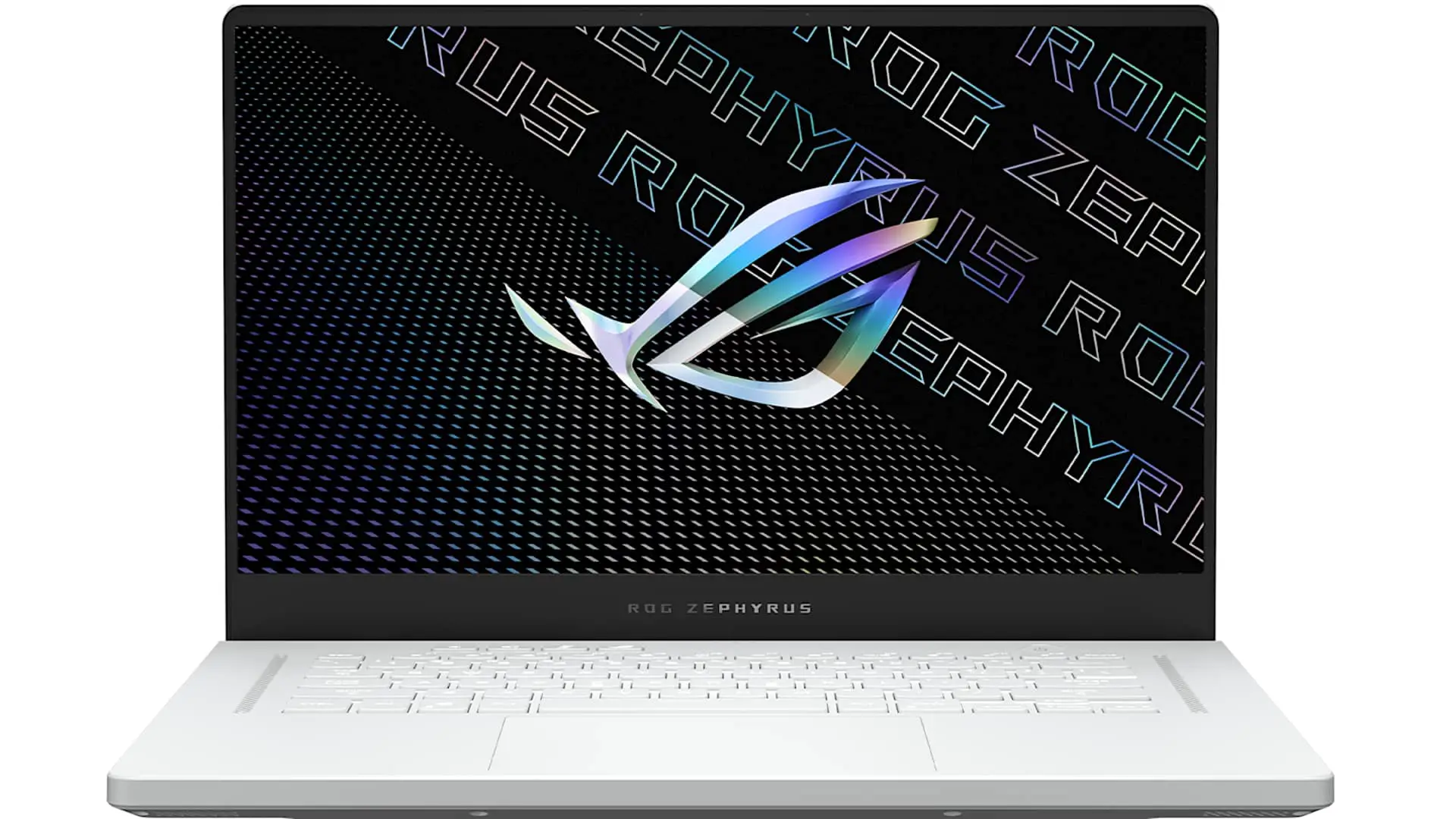
In this article, I give you my ASUS ROG Zephyrus G15 (2021) review with specs included. ROG is pronounced ‘rogue’ or ‘Republic of Gamers, ‘ whatever you want.
This is the 2021 edition of the Asus 15.6-inch thin-and-light kind of classy gaming laptop with the Nvidia RTX 3000 series graphics and AMD Ryzen Zen 3 Cezanne in here.
I’ve got the Ryzen 9 5900HS 8-core 16-thread CPU inside for a lot of performance in a thin package. This has a wide gamut QHD 2560 by 1440 display, which was Nvidia’s promise with the RTX 3000 graphics card, saying that really is the new minimum. If you want to play games, you should enjoy your higher resolution. I’ve got that here too.
I’m pretty excited by this laptop. There are not many RTX 3000 series gaming laptops out yet, but they haven’t been as super exciting as desktop cards because they don’t get as much performance improvement. The desktop cards got that performance boost by using more watts. More power is something you really can’t do much of on laptops.
The Intel CPUs consume more power than AMD and emit more heat. So here, speaking of that, we have AMD Ryzen, and that is a superior CPU in terms of using less heat, having better battery life, and wonderful performance, in multi-core particularly. Intel usually edges out a little bit on a single-core. But the multi-core rocks on AMD.
ASUS ROG Zephyrus G15 (2021) has a QHD matte IPS three-millisecond response time 165-hertz wide gamut display here, and it’s very natural looking. It’s Pantone calibrated, and it’s pretty color accurate. It’s nice, and it’s sharp looking.
If you’re going to play games and you want to see more details, this display does great. For example, when I play Forza Horizon, I really enjoy those higher resolutions because all those trees and the details everywhere make a much prettier game. So, that’s a step in the right direction. It’s also sharp for everyday use if you’re doing photo editing or just reading text.
Let’s see where ASUS ROG Zephyrus G15 (2021) sits amongst the competition. The Zephyrus line is ultra-thin and light. It is one of the thinnest and lightest 15-inch gaming laptops. In fact, it’s just a little bit lighter than not just the Razer Blade 15 Advanced but the 16-inch MacBook Pro too. It’s 1.9 kilograms (which is 4.2 pounds). And it’s quite thin, significantly under an inch. It’s 19.9 millimeters.
ASUS ROG Zephyrus G15 (2021) has a magnesium alloy top and keyboard deck. At the bottom, as far as I can tell, is ABS plastic. It has the 8000 dots on the lid instead of having the LEDs underneath as an optional thing, as they did with the Zephyrus G14.
They have a mylar film underneath those dots, so when you move the lid back and forth, you’ll see color shifting and sort of like having RGB lights without having RGB lights and without using any power.
I think it’s a very clean look on this. Obviously, this design here is very similar to the Zephyrus G14 (2020) model, which is one of the best gaming laptops for value and for what you get for the price.
Again, this laptop is not super cheap, but for what you get, it’s cheaper than the competition, and that’s nice too. The model I have is $1799 MSRP. That gets you the Ryzen 9 5900HS, Nvidia RTX 3070 graphics, the QHD display, 16 GB of RAM, and a fast one-terabyte NVMe SSD. That is not too bad.
You could go up to RTX 3080 and double your RAM to 32 GB while you’re at it, but that’s like $700 more and the performance gain just isn’t that much, especially in a thin and light chassis. So, I would stick with the lower-end model.
So when you compare ASUS ROG Zephyrus G15 (2021) to something like the Razer Blade 15 or 15 Advanced, as a competition, or the MSI GS66 Stealth (which is just a full HD display, there’s no QHD option) it’s hundreds of dollars cheaper while still being pretty premium and focusing on the things that many of us care about the most like the better quality display, the Ryzen CPU inside, that sort of thing.
For the keyboard, you have single-zone RGB backlighting. That means you can choose any color you want, but it’s going to be all one color at a time. That’s fine with me.
There’s no bling, no Rogue Strix RGB body lighting anywhere. Again, with me, that’s fine because I like the staid, kind of modern, and futuristic look, but at the same time very chill design that’s going on here.
We have a very large Microsoft precision trackpad on this. There is no number pad, which, for a 15-inch laptop, personally I like, and that’s up to you to know if you need or just like.
The keyboard on this has a great feel. If you’re a content creator who actually makes use of the written word, you’re going to like this thing. It’s also fine for gaming too.
A nice deep keystroke on these keys, tactile feel springing back; it’s like the good old days of keyboards without getting too thick. And it’s quiet, unlike the Rogue Strix Scar, which has an optimum-mechanical sort of keyboard.
So, within light gaming laptops, some of the things that often take a hit are the sound speakers. Well, they’ve got six speakers on this, including force-cancelling subwoofers. It sounds quite good.
I’m still not sure if it’s as good as the 16-inch MacBook Pro, particularly for the depth of the bass, but compared to just about every other Windows laptop or gaming laptop of this size on the market, it sounds a lot better. And the multiple drivers combined with Dolby Atmos can give you the sense of surround sound that’s very nice.
Some people have said that they hear, at high volumes of the bass particularly, rumbling making funny sounds. Mine is not doing that. I think that’s probably a driver issue, but I don’t know.
Speaking of driver issues, with this machine, out of the box, there were so many driver updates, firmware updates, BIOS updates, etc. I’ve already gotten two BIOS updates. Be sure to actually run those updates, including the My Asus app for BIOS updates, because they do make a difference.
When I first got it out of the box with the shipping BIOS, it did crazy cracky things like sometimes it would say the charger wasn’t plugged in, which got me really worried.
That was purely a BIOS thing because they’re working on a USB-C 100-watt charger to get that going. That is not something that you’re going to use when you’re gaming, but if you need to use it as productivity or a streaming laptop on the go, that will be sufficient. Asus is supposedly going to sell a 100-watt power adapter that’s USB-C-based.
The ASUS ROG Zephyrus G15 (2021) delivers an impressive combination of gaming performance, portability, and battery life. While many thin gaming laptops struggle with heat, the Zephyrus G15 benefits greatly from AMD’s Ryzen processors, which run significantly cooler and more efficiently than competing Intel chips.
During gaming sessions with demanding AAA titles, CPU temperatures typically remained between 80°C and 84°C. That’s a major improvement over many Intel-based gaming laptops, where temperatures often approach 100°C and trigger thermal throttling. The Ryzen 5000-series processor helps maintain strong performance while keeping thermals under control.
Gaming performance is excellent for a laptop this thin and light. In Cyberpunk 2077 running at the native 2560×1440 resolution with maximum settings and ray tracing disabled, frame rates generally stayed in the mid-60 FPS range. Enabling ray tracing naturally lowers performance, though NVIDIA DLSS can help recover some of the lost frame rate while maintaining image quality.
What’s especially impressive is how the Zephyrus G15 compares to much larger gaming systems. In testing, performance came surprisingly close to a much heavier desktop-replacement laptop equipped with a desktop-class Intel Core i7 processor and a full-power RTX 2070 Super. Considering the size and weight differences, the G15 represents a significant leap forward in gaming laptop efficiency.
Surface temperatures are also very well managed. The only noticeably warm area is located above the keyboard, where users rarely make contact. The keyboard deck itself stays comfortable during extended gaming sessions, and the laptop can even be used on your lap without becoming uncomfortable. However, it’s important to avoid blocking the ventilation openings on the bottom of the chassis.
Fan noise is present under heavy gaming loads, as expected from any thin gaming notebook, but the fans produce a smooth airflow sound rather than an irritating high-pitched whine. Most testing was performed using ASUS’s Performance mode, which provides an excellent balance of cooling, noise levels, and performance. Turbo mode delivers a small increase in frame rates but also results in slightly higher temperatures and louder fan operation.
The GeForce RTX 3070 configuration uses a lower power limit than larger gaming laptops, operating at 80 watts with dynamic boosts up to 100 watts. While it won’t match the performance of full-power RTX 3070 implementations found in thicker laptops, the results are remarkably strong given the G15’s slim design. This also raises questions about the value of the RTX 3080 version, which shares similar power limitations and therefore offers less of a performance advantage than expected.
One compromise is the lack of a dedicated MUX switch. Users cannot disable NVIDIA Optimus and run exclusively on the dedicated GPU when using the built-in display. This can reduce gaming performance slightly compared to laptops that offer a direct GPU connection. However, ASUS prioritizes battery life and thermal efficiency, which aligns with the Zephyrus series’ focus on portability.
For users seeking maximum gaming performance, connecting an external display through the USB-C port provides a direct connection to the dedicated GPU. This bypasses Optimus and allows the system to achieve its highest possible gaming performance.
Internally, the laptop features a well-designed cooling system with dual fans and multiple heat pipes. Storage expansion is excellent, thanks to two PCIe Gen 3 M.2 SSD slots. Memory, however, follows ASUS’s familiar design approach, combining soldered RAM with a single upgradeable memory slot.
The 16GB configuration includes 8GB soldered to the motherboard and one 8GB memory module. Upgrading the removable module increases total memory capacity, but only a portion of the RAM continues operating in dual-channel mode. For gaming, this limitation is generally not a major concern, but content creators and professional users working with large projects may notice the impact.
Wireless connectivity includes Intel Wi-Fi 6 and Bluetooth 5 support. The power button also incorporates a fingerprint reader, although reliability can be inconsistent and may require multiple attempts before recognizing a fingerprint.
Compared to competitors, the Zephyrus G15 offers a compelling value proposition. It combines AMD Ryzen efficiency, strong RTX 3000-series graphics performance, a premium QHD display, and excellent portability at a price that often undercuts similar premium gaming laptops.
The port selection is particularly strong. Users get USB-C 3.2 Gen 2 with DisplayPort 1.4 support and power delivery, two USB-A 3.2 Gen 2 ports, HDMI 2.0b, Gigabit Ethernet, a microSD card reader, and a headphone jack. The only major omission is Thunderbolt support, which remains exclusive to Intel platforms.
Battery life is one of the laptop’s standout features. Thanks to the combination of AMD Ryzen efficiency and a large 90Wh battery, users can expect between six and nine hours of runtime during productivity tasks such as web browsing, video streaming, office work, and light photo editing. This level of endurance is exceptional for a gaming laptop.
The included 200-watt charger is also relatively compact and lightweight, making it easier to carry compared to the bulky power adapters often bundled with high-performance gaming notebooks.
Opening the laptop reveals a clean internal layout. The large battery occupies much of the chassis, while dual SSD slots provide ample storage expansion opportunities. ASUS also includes a six-speaker audio system, which delivers surprisingly good sound quality for a laptop of this size.
Cooling is aided by liquid metal thermal compound applied to the CPU, helping improve heat transfer and reduce operating temperatures. Combined with the extensive heat pipe system, this allows the Zephyrus G15 to achieve strong performance without excessive heat buildup.
Overall, the ASUS ROG Zephyrus G15 (2021) is one of the most impressive gaming laptops of its generation. It combines excellent gaming performance, strong battery life, a beautiful QHD high-refresh-rate display, premium build quality, and outstanding portability. While the soldered memory design and lack of a MUX switch may disappoint some enthusiasts, the overall package remains highly attractive.
For gamers looking for a thin, professional-looking laptop capable of running modern AAA games at 1440p resolution with smooth frame rates, the Zephyrus G15 stands out as one of the best options available.
ASUS ROG Zephyrus G15 (2021)
-
Performance - 98%98%
-
Price - 94%94%
-
Value - 96%96%