
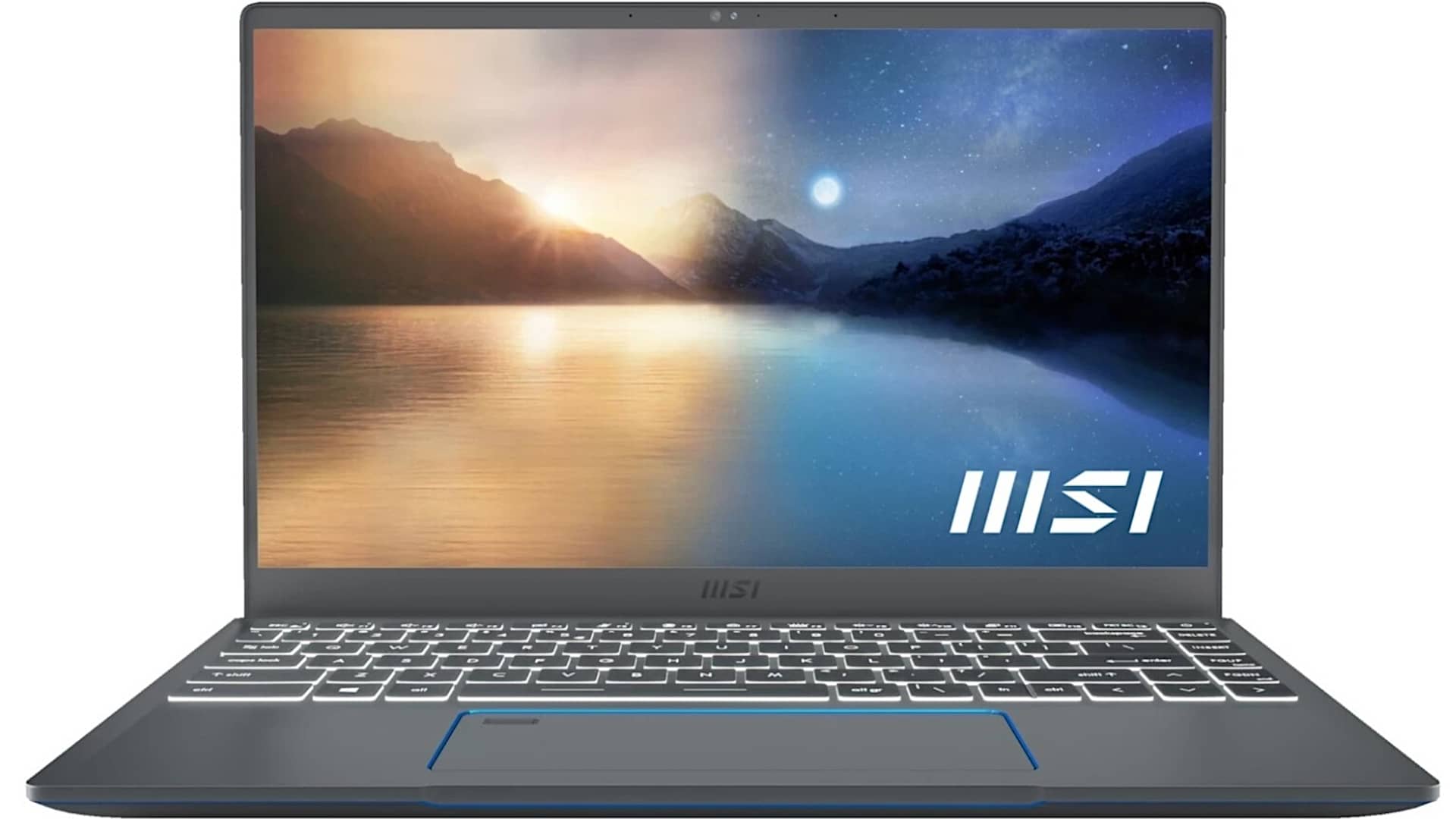
MSI is predominantly known for gaming laptops, and its mobile workstations have earned a solid reputation in creative professional circles. The business ultrabook market is a different arena entirely, and the Prestige 14 Evo represents the company’s continued push into that space. It is worth clarifying upfront that two versions of the Prestige 14 exist. The standard Prestige 14 includes Nvidia GTX 1650 Max-Q dedicated graphics but does not carry Intel’s Evo platform certification. The Evo model reviewed here is the opposite: it is a full Intel package, meeting the Evo platform requirements for long battery life, instant wake from sleep, Intel integrated graphics, and Intel Wi-Fi, with no discrete GPU on board.
Breaking into the premium business ultrabook category is no small task. The competition is well established and in some cases iconic. The Dell XPS 13 has defined the segment for years, and a range of ThinkPad models including the X1 Carbon carry decades of enterprise credibility. MSI’s approach to competing is straightforward: come in at a lower price. A Core i7 configuration with a Full HD IPS display, 16GB of RAM, and a 512GB to 1TB NVMe SSD lands at approximately $1,199, undercutting many rivals at equivalent specifications.
Design, Build, and First Impressions
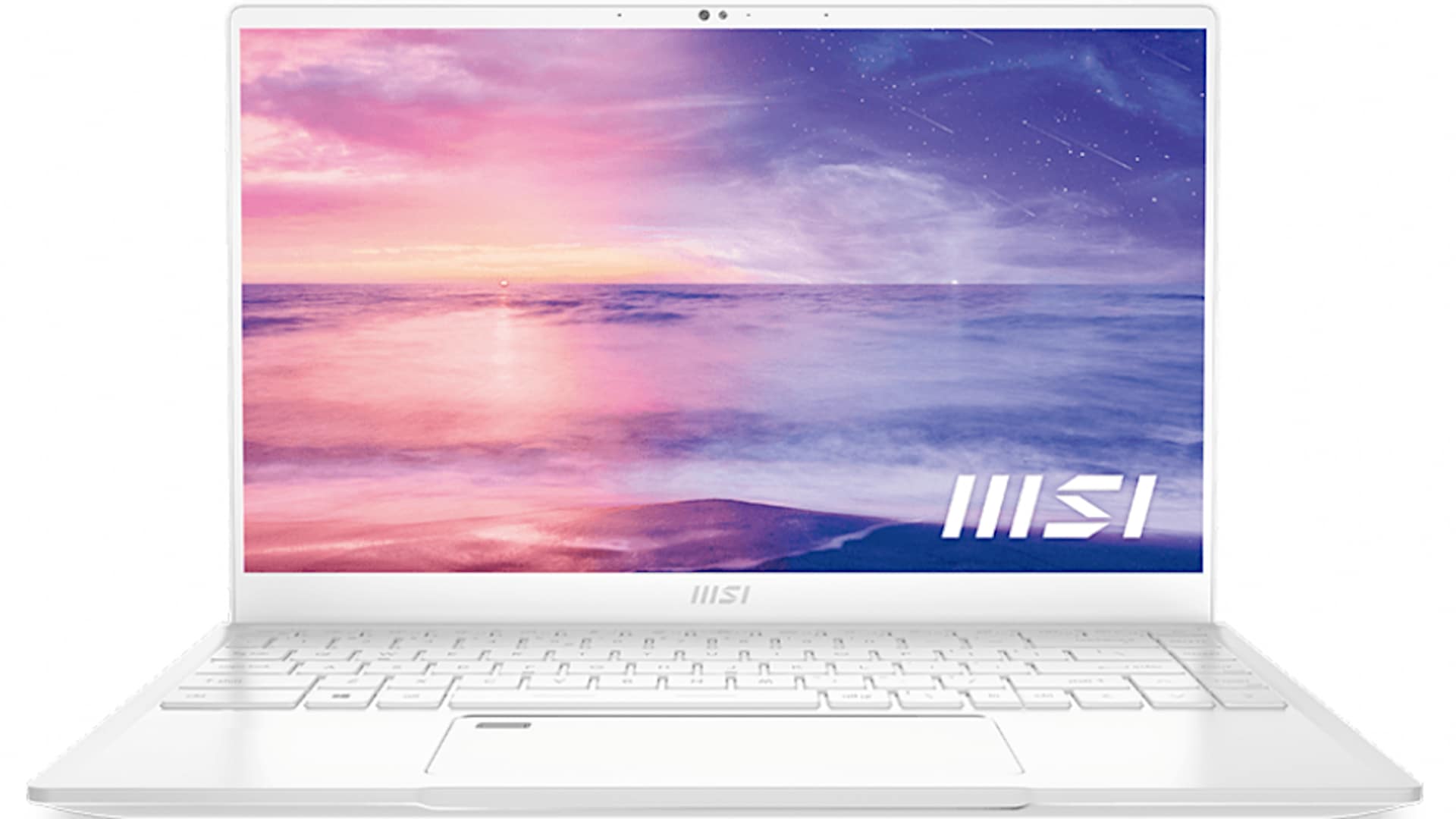
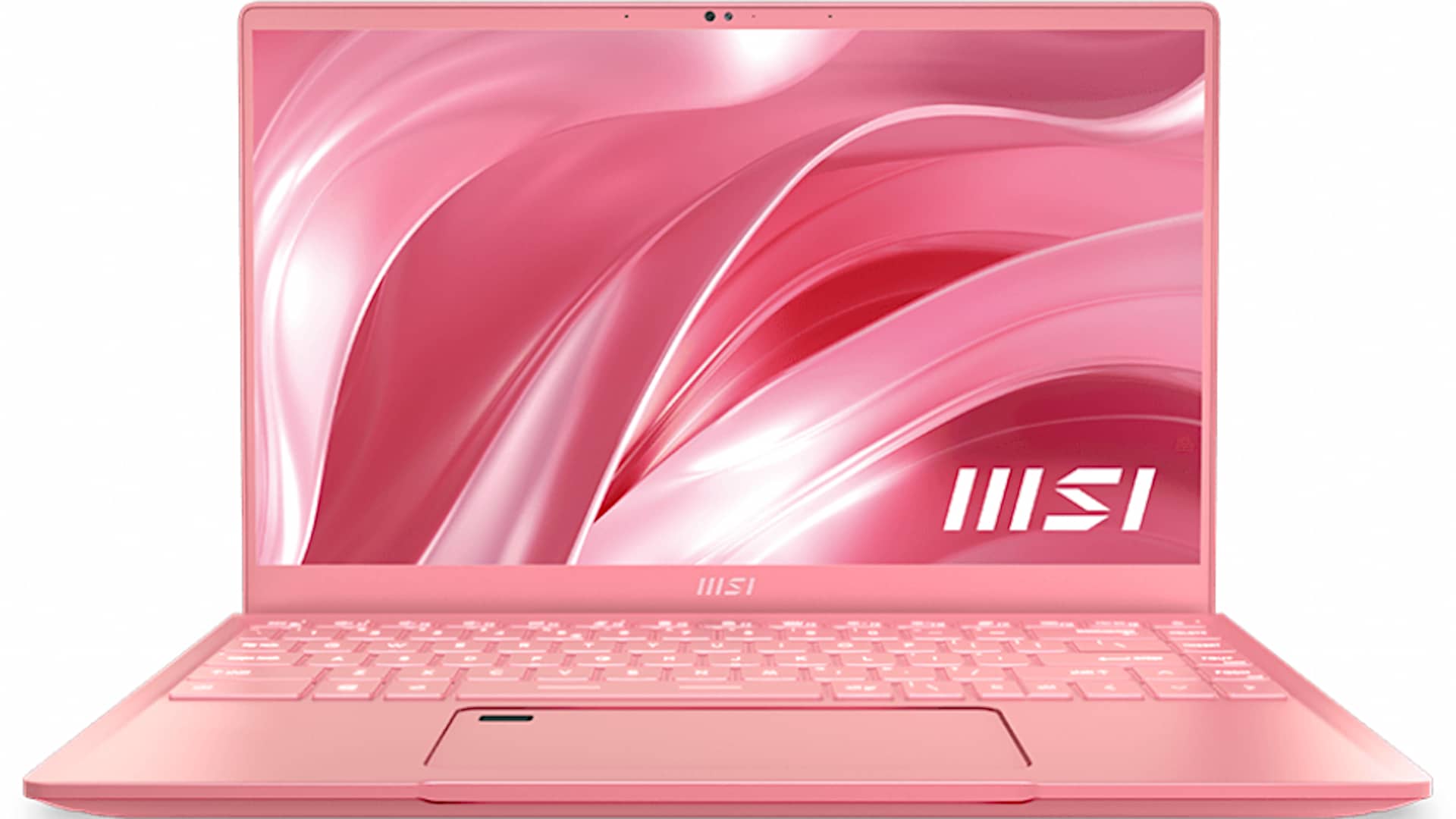
The Prestige 14 Evo is a conventional 14-inch clamshell laptop with no convertible functionality. The body is aluminum throughout, and the machine is available in three colours. The reviewed unit is listed as gray but features subtle bluish metallic accents along the edges, giving it a slightly distinctive character. White and pink options are also available, with the pink being a bold, unambiguous choice.
The finish on the gray model uses a sparkly paint texture that reads as somewhat dated, recalling the aesthetic of plastic consumer laptops from the early 2000s rather than the refined matte or brushed finishes favoured by the premium ultrabook category today. The white variant appears less prone to this effect in photographs, and the pink carries its own deliberate visual identity. The aluminum construction itself is solid, and the chassis feels sturdy, so the reservation is purely aesthetic rather than structural.
One thoughtful ergonomic detail: opening the laptop slightly lifts the rear of the keyboard deck by approximately five degrees. This angle improves typing ergonomics and provides a small but meaningful benefit to cooling airflow beneath the chassis.
Display Performance
The Prestige 14 Evo ships with a Full HD 1920×1080 IPS panel at the traditional 16:9 aspect ratio. Buyers hoping for the taller 16:10 or 3:2 formats that have become increasingly common in premium ultrabooks will need to look elsewhere. The display measures 305 nits of brightness in testing with a SpyderX Elite colorimeter, which is noticeably dimmer than many competitors in the $1,000 to $1,200 price bracket. For indoor use under controlled lighting, this is workable, but outdoor or bright-environment use will be less comfortable than on brighter alternatives.
Where the display makes up some ground is in contrast and colour accuracy. Black levels are impressively low, meaning dark content and shadow detail reproduce with genuine depth rather than the washed-out appearance common on lower-quality panels. Colour gamut coverage is also solid, making the display capable for photo work and general creative use. MSI lists 4K display options on their product pages, but no specific configuration with a 4K panel was identified at the time of this review.
Processor, Graphics, and Performance
The Intel 11th Generation processor inside the Prestige 14 Evo belongs to the ultrabook CPU class, though this generation is capable of pushing up to 28 watts under sustained load, a meaningful increase over previous-generation ultrabook chips. The configuration offers either a Core i5 or Core i7 option, both quad-core with eight threads. The reviewed unit uses the G7 variant, which pairs the CPU with Intel Iris Xe integrated graphics.
Iris Xe represents a substantial step forward for Intel integrated graphics. For casual gaming, older titles, and GPU-assisted tasks like photo editing and light video work, it provides noticeably better performance than the integrated graphics found in previous-generation ultrabooks. In default balanced mode, benchmark results are competitive with comparable machines, though the Razer Book 13 edges ahead. Switching to performance mode in MSI’s software closes this gap further, though it comes at the cost of increased fan noise, which is at odds with the quiet, professional character most business ultrabook users prefer.
MSI’s background in gaming hardware is evident in the thermal solution. The heatsink assembly is unusually substantial for a machine with integrated graphics only, featuring heat pipes that are longer and wider than typically seen in this category, along with a larger fan than most ultrabook competitors deploy. This investment in cooling capacity provides thermal headroom that keeps performance consistent under sustained workloads.
Keyboard and Trackpad
The keyboard offers 1.5mm of key travel with white backlighting. The tactile feedback is acceptable but does not stand out in a competitive segment where HP EliteBooks and ThinkPads set a notably high bar for keyboard quality. For a laptop positioning itself as business-oriented, the typing experience could benefit from a more decisive, satisfying keystroke. It is not uncomfortable to type on, but it will not win converts from users accustomed to ThinkPad keyboards.
MSI retains a few layout quirks that require adjustment. The function key has been moved from the left side of the keyboard to the right, reversing the conventional placement. The power button replaces the Delete key position, which creates a real risk of accidentally putting the machine to sleep when reaching for the Delete key by muscle memory. Neither of these decisions aligns with standard business laptop conventions, and both require deliberate relearning.
The trackpad is wide, consistent with the previous generation, and integrates a fingerprint scanner in its surface. A Windows Hello infrared camera is also included for facial recognition login. The trackpad uses Microsoft Precision drivers and functions accurately, but the surface is extremely smooth, to the point where the cursor can be difficult to control with precision. The friction level is lower than ideal, and the experience improves somewhat as natural skin oils accumulate on the surface over time.
Connectivity and Ports
Networking is handled by the Intel Wi-Fi 6 AX201 card with Bluetooth 5.1. There is no LTE or 5G option available, which is a common omission in this price bracket but worth noting for users who need cellular connectivity on the move.
Port selection is one of the Prestige 14 Evo’s genuine strengths relative to some competitors. Two Thunderbolt 4 ports cover high-speed data transfer and external display connectivity. A USB-A port is also present, which immediately distinguishes it from laptops that force users to carry a dongle for basic peripherals. One significant caveat is that this USB-A port operates at USB 2.0 speeds, a specification rarely seen in a laptop of this generation and likely to frustrate users who expect USB 3.0 performance for storage transfers. A microSD card slot rounds out the options for content creators, and a standard 3.5mm headphone jack is included.
Battery Life and Charging
The 52Wh battery is competitive for the category, and the Intel Evo platform certification demands strong real-world battery performance, a requirement the Prestige 14 Evo meets. Under a light productivity workload comprising office applications, casual browsing, limited streaming, and occasional photo editing at 200 nits of brightness, eight to nine hours of run time is achievable. This is a solid result that holds up well against rivals.
A 65-watt fast charger is included and supports rapid top-up charging. MSI states that 15 minutes of charging provides approximately 90 minutes of run time, which is a convenient feature for users who need a quick boost before heading out.
Internal Layout and Upgradeability
Removing the bottom cover is more straightforward than on MSI’s gaming laptops. All Phillips head screws are visible except for the one concealed beneath the standard factory seal sticker. A guitar pick or similar prying tool releases the cover after the screws are removed.
Inside, the 52Wh battery occupies a central position. The NVMe SSD, a Kingston 1TB unit in the reviewed configuration, is accessible and replaceable, though it appears to operate at PCIe 3.0 speeds despite the platform theoretically supporting PCIe 4.0. Stereo speaker drivers flank the battery in the palm rest area and produce sound that is modest in volume but decent in quality for the size. The Intel Wi-Fi card is socketed and can be replaced if needed. RAM is soldered to the motherboard, as is standard practice across the ultrabook category, making the pre-purchase RAM selection a permanent decision.
How It Compares to the Competition
The Prestige 14 Evo does not offer a single feature that makes it an obvious, must-have choice over its rivals. What it provides instead is a competent package at a price below most comparable alternatives, combined with a port selection that is more practical than several higher-priced competitors.
Against the Dell XPS 13, the MSI is larger at 14 inches versus 13 inches, but the XPS commands a price premium of roughly $300 to $400 for equivalent specifications. The Apple MacBook Air with the M1 processor starts at $1,399 for 16GB of RAM and 512GB of storage, offering superior battery life and CPU performance but no Windows compatibility. HP EliteBooks and ThinkPad models aimed at enterprise buyers typically cost more and target organisations with managed IT environments rather than individual consumers.
For buyers who value price efficiency, practical port selection, solid battery life, and a lightweight aluminum build without requiring the absolute best display brightness or keyboard feel on the market, the Prestige 14 Evo presents a compelling case. It is not the most exciting ultrabook available, but it delivers on its core promises without unnecessary compromise, and at its price point, that is exactly what the market needs from it.
MSI Prestige 14 Evo (2021)
-
Performance - 95%95%
-
Price - 95%95%
-
Value - 95%95%