
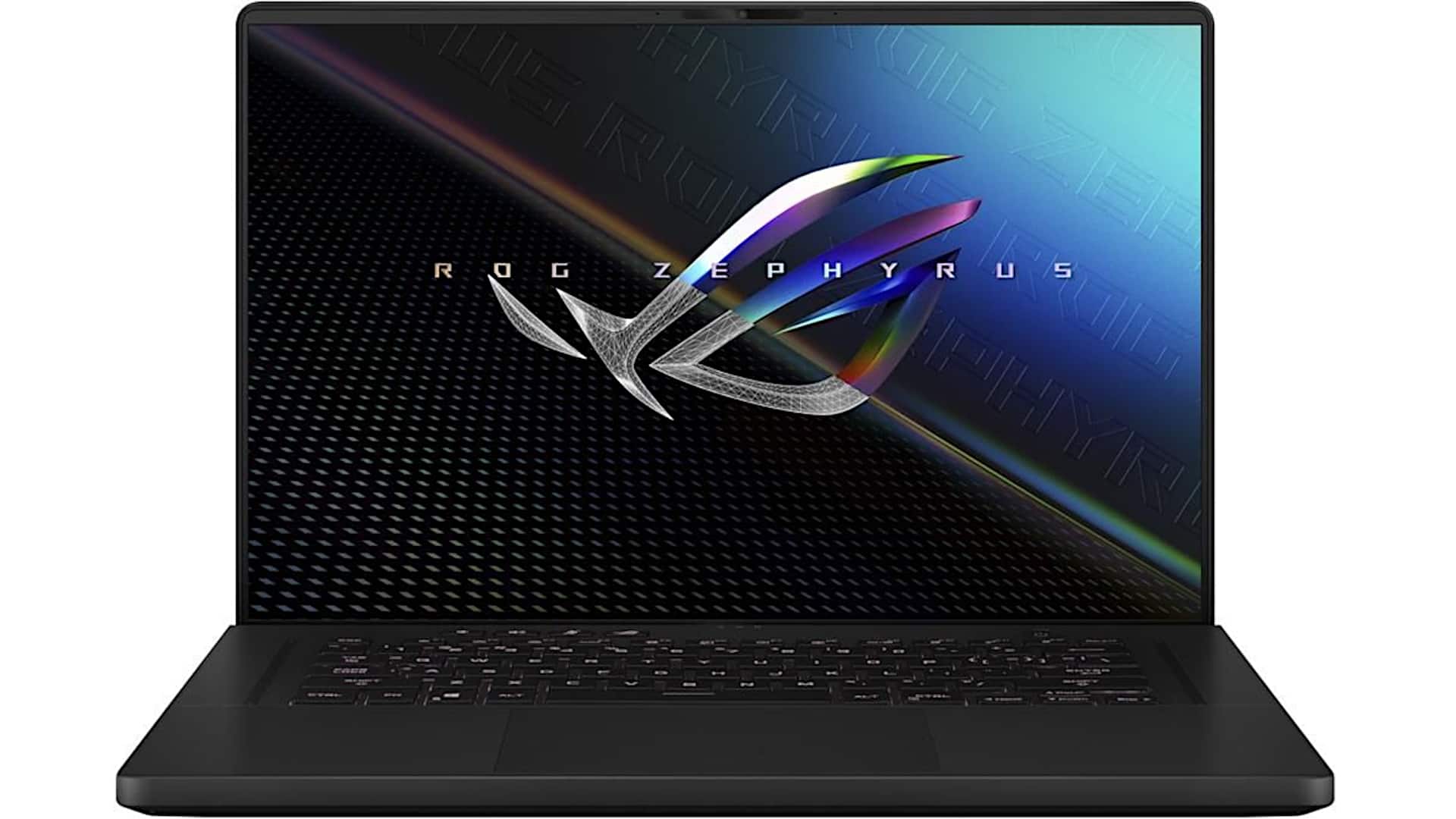
In this article, I give you my Asus ROG Zephyrus M16 review with specs included. This is the same G15 chassis, and I reviewed the G15 a couple of months prior (here is the link so you can check that out too).
It has a 16-inch display instead of 15.4 because it is a 16: 10 aspect ratio. So they made it a little bit taller, upped it by .6 inches. That’s really cool, I like it.
As a side note, the Lenovo Legion 5 Pro that I also reviewed has that aspect ratio and resolution QHD plus display.
Asus ROG Zephyrus M16 has one of the first Intel 11th generation Tiger Lake H-45 CPUs inside. In fact, it’s a Core i9. You can get it with Nvidia RTX 3050Ti, 3060, or 3070 graphics. I have the 3060 model.
Obviously, this is the successor to the Zephyrus M15, which was an Intel-based platform. An Intel 10th-generation CPU with RTX 2070 Max-Q graphics, for example, is one of the options there. And for this one, certainly, there’s a lot of CPU improvement.
I was a little bit worried about Intel, especially when I tested some other 11th gen CPU that ran awful hot and loud because it was in the thin and light design and it was the overclockable i9.
Asus ROG Zephyrus M16 does not have the highest-end i9 CPU, and it’s also available with the i7, and the thermals here are almost too under control.
The ASUS ROG Zephyrus M16 brings Intel’s latest hardware to the popular Zephyrus lineup, offering a compelling mix of gaming performance, creator-focused features, and premium portability. While it shares much of its design with the Ryzen-powered Zephyrus G15, the M16 introduces Intel-exclusive technologies such as Thunderbolt 4 and PCIe 4.0 support.
One of the key advantages of the Intel platform is Thunderbolt 4 connectivity. Users who require high-speed external storage, docking stations, or advanced display support will appreciate having Thunderbolt available. The system also supports PCIe 4.0 storage, although many retail configurations ship with PCIe 3.0 SSDs to keep costs down. For most users, the difference in real-world performance is minimal, but professional creators working with large 4K or 8K video projects may benefit from faster PCIe 4.0 drives.
ASUS has also improved the fingerprint reader. While previous ASUS gaming laptops sometimes struggled with fingerprint recognition, the M16’s scanner is noticeably more reliable and generally works well for quick logins.
The keyboard features single-zone RGB backlighting, allowing users to choose from a wide range of colors and lighting effects. Unlike gaming laptops with per-key RGB illumination, the entire keyboard displays a single selected color at any given time. This approach fits the M16’s more professional appearance.
Although part of the Zephyrus gaming family, the M16 clearly targets both gamers and content creators. It competes not only with gaming-focused systems such as the Razer Blade 15 and MSI GS66 Stealth but also creator-oriented laptops like the 16-inch MacBook Pro. Compared to the Zephyrus G15, the M16 leans more heavily toward creative workloads rather than pure gaming performance.
The design is sleek and understated. There are no flashy RGB light bars or aggressive gaming accents. Instead, the laptop features a clean black finish with magnesium alloy construction on the lid and bottom panel. The soft-touch coating on the keyboard deck feels premium while resisting fingerprints reasonably well.
A large glass touchpad provides a smooth and responsive experience, and the keyboard offers 1.7mm of key travel, making it comfortable for both typing and gaming.
Portability remains one of the M16’s strengths. ASUS lists the weight at approximately 4.2 pounds, although real-world measurements place it slightly higher. Even so, it remains impressively portable for a 16-inch performance laptop. The larger 240W power adapter adds some extra weight compared to the G15, but the overall package remains travel-friendly.
Unlike many recent ASUS gaming laptops, the M16 includes a built-in webcam. While the 720p camera won’t impress content creators, it is perfectly adequate for video conferencing. The microphones, on the other hand, perform surprisingly well and deliver clear voice quality.
One of the biggest highlights is the display. The 16-inch 16:10 panel offers exceptional image quality with full DCI-P3 color coverage and nearly 90% Adobe RGB coverage. Brightness reaches approximately 550 nits, which is significantly higher than most gaming laptops and makes the display suitable for outdoor use and professional content creation.
The QHD+ resolution of 2560×1600 provides excellent sharpness, while the 165Hz refresh rate delivers smooth gaming performance. Combined with the taller 16:10 aspect ratio, the display feels noticeably more spacious than traditional 15-inch gaming screens.
Some users have expressed concerns about ASUS’s rear exhaust design, which directs warm air toward the lower portion of the display. Testing showed temperatures around 50°C near the exhaust area during heavy workloads. While this sounds warm, ASUS has used similar designs in previous models without widespread display reliability issues.
Audio quality is another strength. The six-speaker system produces clear, full sound that exceeds what most gaming laptops offer. While it doesn’t quite reach the level of Apple’s MacBook Pro speakers, it remains among the better audio solutions available in a Windows gaming laptop.
The cooling system is extremely aggressive. Fan noise can reach nearly 60 decibels in Turbo mode, making the M16 one of the louder thin-and-light gaming laptops. Fortunately, the fan sound is more of a strong airflow noise than an irritating high-pitched whine.
The benefit of this cooling approach is excellent thermal performance. During demanding games such as Cyberpunk 2077, CPU temperatures often stayed between 75°C and 80°C, which is remarkably cool for a high-performance Intel laptop. GPU temperatures also remained well-controlled. ASUS appears to have prioritized cooling performance, even if it comes at the expense of quieter operation.
Gaming performance with the RTX 3060 configuration is solid, but the high-resolution QHD+ display presents a challenge. While the RTX 3060 handles 1080p gaming comfortably, maintaining high frame rates at 2560×1600 often requires lowering graphics settings or disabling ray tracing. The upcoming RTX 3070 configuration should provide a better balance for gaming at the panel’s native resolution.
For content creators, however, the M16 excels. The Intel Core i9-11900H delivers outstanding performance in applications such as Adobe Premiere Pro, Blender, and other demanding creative workloads. CPU clock speeds remain impressively high even during extended heavy use, allowing the processor to maintain strong performance over time.
Compared to Intel’s previous generation, the Core i9-11900H offers a significant performance improvement and competes closely with AMD’s Ryzen 9 5900HX in many tasks.
External display support requires some attention. The Thunderbolt 4 port is connected to the integrated graphics, while the USB-C DisplayPort connection links directly to the dedicated NVIDIA GPU. Users seeking maximum gaming performance on an external monitor should connect through the USB-C DisplayPort connection rather than Thunderbolt.
GPU power limits vary by configuration. The RTX 3060 model operates at up to 95 watts with Dynamic Boost, while the RTX 3070 version reaches 100 watts. The RTX 3050 Ti configuration runs at 75 watts. These power levels place the M16 toward the higher-performing end of thin-and-light gaming laptops.
Internally, ASUS continues using its hybrid memory configuration. Part of the memory is soldered to the motherboard while a single upgradeable RAM slot remains available. Depending on the model, users receive either 8GB or 16GB of soldered DDR4-3200 memory paired with a matching removable module.
Storage expansion is excellent thanks to dual M.2 NVMe SSD slots. While PCIe 4.0 is supported, most U.S. configurations include PCIe 3.0 SSDs, which remain extremely fast for everyday use.
One surprising choice is the inclusion of a MediaTek Wi-Fi card instead of the Intel wireless adapters commonly found in Zephyrus laptops. While functionality is generally acceptable, some users have reported compatibility issues with certain Wi-Fi 6 routers. Fortunately, the wireless card is socketed and can be replaced if necessary.
Connectivity is outstanding. The laptop includes HDMI 2.0b, Thunderbolt 4, USB-C, multiple USB-A ports, Gigabit Ethernet, a microSD card reader, and a headphone jack. The wide selection of ports reduces the need for adapters and makes the system versatile for both gaming and professional use.
Battery life is respectable but not class-leading. The large 90Wh battery delivers around six and a half hours of mixed productivity and media consumption when configured correctly to use integrated graphics while unplugged. While this is good for a gaming laptop, AMD-powered alternatives still offer noticeably longer battery life.
Overall, the ASUS ROG Zephyrus M16 is a premium laptop that successfully bridges the gap between gaming and content creation. It combines a stunning 16:10 display, excellent performance, strong build quality, extensive connectivity, and impressive cooling capabilities. The loud fans and shorter battery life compared to Ryzen competitors are its biggest drawbacks, but for users who value Thunderbolt 4, Intel performance, and a superb display, the M16 remains one of the most compelling thin-and-light gaming laptops of its generation.
Asus ROG Zephyrus M16
-
Performance - 95%95%
-
Price - 94%94%
-
Value - 95%95%