
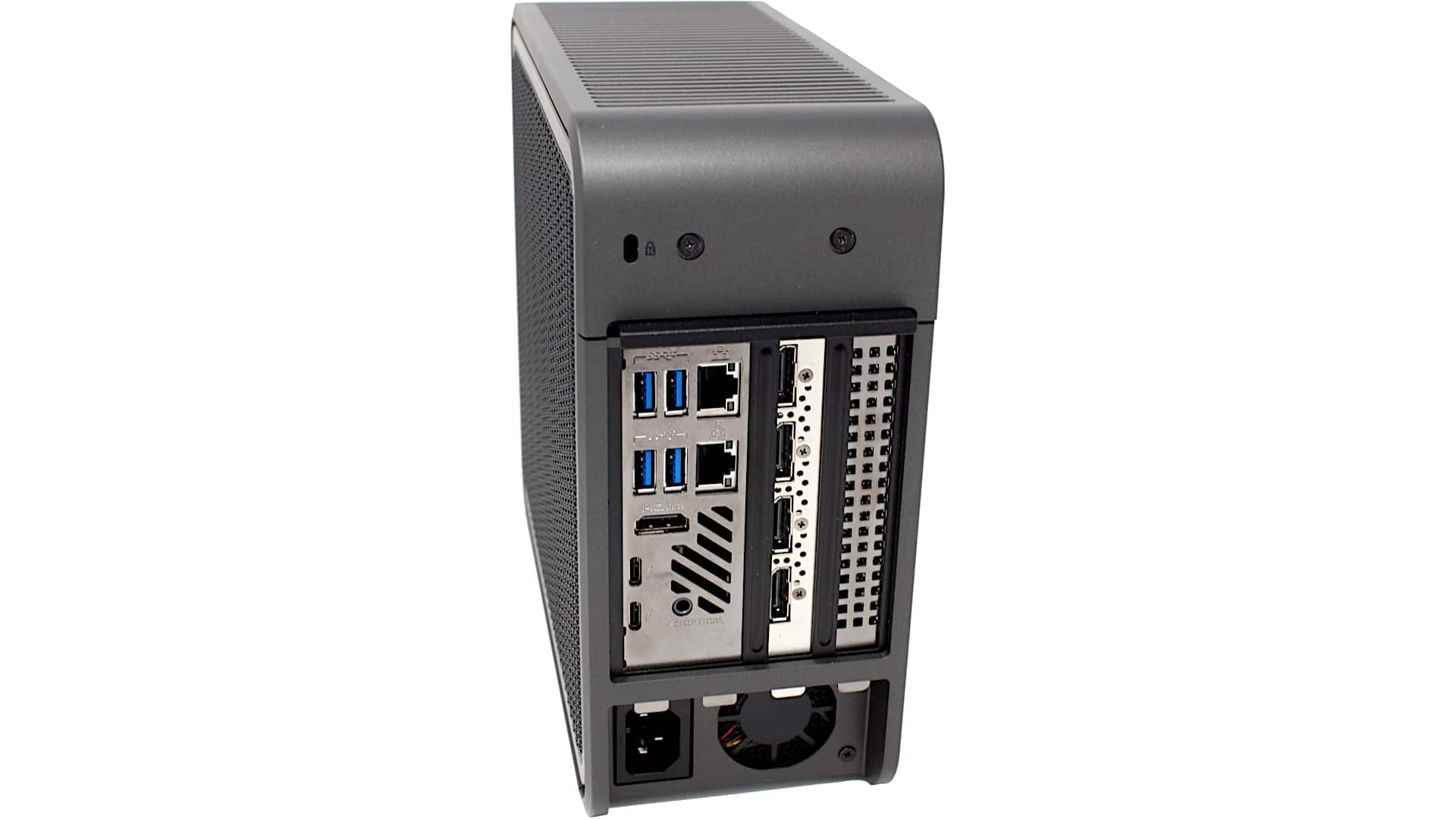
The Intel NUC 9 Pro is not your typical NUC. For those unfamiliar with the product line, NUC stands for Next Unit of Computing, and Intel’s standard NUC machines are roughly the size and performance equivalent of a decent ultrabook. The NUC 9 Pro is something else entirely. It is physically larger than the classic palm-sized NUC models and significantly more powerful, designed to serve as a compact workstation or high-performance desktop replacement for professionals and enthusiasts who need serious computing in a small footprint.
The NUC 9 Pro comes in two distinct configurations: the Quartz Canyon, which is the focus of this review, and the Ghost Canyon. The key differentiator between the two is the processor. The Quartz Canyon ships with either an Intel Xeon E-2286M or a Core i7-9850H, both of which are 9th Generation Intel chips in the 45-watt class. These are the same processors found in mobile workstations and high-performance laptops rather than ultrabooks, and that distinction matters enormously for the kind of workloads this machine is designed to handle. This is not a machine for browsing the web or light document work. It is built for serious professional tasks, from CAD and 3D modeling to video production and data processing.
Processor Options and Target Audience
The choice between the Core i7 and Xeon variants of the NUC 9 Pro essentially defines the intended use case. The Core i7-9850H version is better suited for users who lean toward gaming and general high-performance computing, while the Xeon E-2286M is aimed squarely at mobile workstation users who need ECC memory support and the kind of reliability that Xeon processors are known for in professional environments.
Both processors belong to Intel’s 45-watt H-series family, which sets them apart from the lower-power U-series chips commonly found in compact NUC models. The thermal and power demands of these chips would normally require a large laptop chassis or a full desktop to manage properly. The NUC 9 Pro achieves something quite impressive by housing this level of processing power in a form factor compact enough to fit almost anywhere.
Graphics and Expansion
One area where the NUC 9 Pro distinguishes itself from many small form factor competitors is its support for discrete graphics cards. The unit features two PCIe slots, one of which is a full x16 slot capable of accepting a double-wide card. This opens up a meaningful range of GPU options, which is not something you can say about most machines this size.
Intel supplied our review unit with an Nvidia Quadro P2200 from PNY, which is well-matched to the Xeon configuration for professional visualization and CAD workloads. For users opting for the Core i7 version with gaming in mind, there is also an RTX 2070 option available. The catch is that the chassis only accommodates cards up to 8 inches in length, which rules out most standard full-size desktop GPUs. The solution comes from Asus, which produces what it calls the Dual Mini, a compact RTX 2070 that fits within the length constraint while delivering performance comparable to a standard desktop card. It carries a price tag of around $420, but the performance-to-size ratio makes it a reasonable choice for this platform.
The system also supports graphics cards with power requirements up to 225 watts, with both a 6+2-pin and a 6-pin connector available internally. That is more than enough headroom for capable mid-range and upper-mid-range GPU options.
Thermal Performance and Cooling Design
Thermal performance is one of the NUC 9 Pro’s strongest selling points, and it addresses one of the most common frustrations with compact, high-performance computing. Machines using 45-watt H-series processors in laptop form typically see CPU temperatures climb into the mid-90s Celsius under sustained load due to the constraints of thin and light chassis design. The NUC 9 Pro tells a very different story.
During benchmarking, including demanding tests like the CPU-intensive portions of 3DMark Fire Strike, temperatures consistently landed in the 60s to 70s Celsius range. That is a remarkable improvement over what you would expect from a laptop housing the same processor, and it speaks to the quality of the thermal design. The taller, boxier form factor allows for a much more effective cooling layout than any flat laptop chassis could achieve.
Both side panels of the NUC 9 Pro are mesh grilles that slide out with minimal effort, maximizing passive airflow through the chassis. The top of the unit houses two large fans and is removable with just two Phillips head screws. This combination of large fan surface area, extensive mesh ventilation on multiple sides, and an internal power supply with its own dedicated cooling fan results in a system that stays genuinely cool even under demanding workloads. Despite all that cooling hardware, it is not a particularly loud machine, which is a welcome surprise given what is running inside.
Memory and Storage
The NUC 9 Pro uses a compact internal motherboard that houses two DDR4 2666MHz RAM slots, the same standard used in laptops. Maximum supported capacity is 64GB, which is ample for demanding professional workloads including video editing, large dataset processing, and complex 3D modeling. Our review unit came configured with 32GB, which is worth keeping in mind when interpreting the benchmark results.
Storage options are generous for a machine this size. The internal motherboard provides two M.2 NVMe slots that also support SATA 3, and an additional M.2 slot is located near the power supply section, connected directly to the CPU rather than the PCH. This third slot enables RAID 0 or RAID 1 configurations using a pair of M.2 drives, which is a feature you would not typically expect to find in a compact desktop of this nature. For users who need fast storage redundancy or striped performance without a traditional desktop tower, this is a genuine advantage.
The internal power supply is another thoughtful design choice. Rather than relying on an external power brick, the NUC 9 Pro integrates the power supply directly into the chassis with its own dedicated fan, keeping the cable management clean and the desk tidy. There is no large external adapter to trip over or lose.
The Compute Element and Modularity
One of the most intriguing aspects of the NUC 9 Pro is its modular architecture, built around what Intel calls a Next Unit of Computing compute element. This is essentially a self-contained mini motherboard that houses the processor, RAM slots, and primary SSD slots, and it connects to the main chassis via a PCIe slot, much like a card slotting into a desktop motherboard.
The compute element can be removed with just a single screw, making it theoretically straightforward to swap in a next-generation unit as new processors become available. Whether that upgrade path proves cost-effective in practice depends on how Intel prices future compute elements and when they become available, but the concept is forward-thinking and represents a genuine attempt to give compact PC users an upgrade path beyond the typical buy-and-replace cycle.
Accessing the internals more generally is easier than most small form factor machines. Removing the top cover and one side panel gives immediate access to the GPU bay. Removing the GPU then reveals a hinged door that provides quick access to the RAM slots and the top M.2 SSD slot. For deeper access to components at the bottom of the chassis, the entire compute element can be extracted. The process is logical, well-organized, and satisfying for anyone who enjoys hands-on tinkering.
Ports and Connectivity
For a machine this compact, the port selection on the NUC 9 Pro is impressively comprehensive. The rear panel includes two Thunderbolt 3 ports, multiple USB connections, HDMI output from the integrated Intel UHD 630 graphics, and whatever display outputs your chosen discrete GPU provides. Both front and rear audio jacks are present, with S/PDIF digital audio output available at the rear. Two Gigabit Ethernet ports are included, which is a thoughtful addition for users who run network-intensive workloads or want a backup wired connection. A full-size SD card slot on the front panel rounds out the connectivity options.
This level of connectivity is more than adequate for most professional workflows and eliminates the need for docking stations or adapters in most scenarios.
Pricing and Value
The Intel NUC 9 Pro is not inexpensive. Starting prices for the Core i7 version sit around $1,500, while the Xeon configuration can approach $2,000. These prices represent the base cost of the unit and do not necessarily include RAM, storage, or an operating system. Configured units with RAM and an SSD included can be found through retailers like SimplyNUC or Amazon at prices in a similar range, making the real-world cost of entry somewhat more digestible for buyers who want a ready-to-use system.
The cost is high, but it reflects what you are getting: workstation-grade processing in a form factor that fits in a briefcase, with thermals that outperform laptops using the same processors, meaningful upgrade potential, and a build quality that feels premium throughout. For the right buyer, particularly those working from home who need serious computing power but cannot accommodate a full tower, the value proposition makes sense. For those simply looking for the cheapest route to high performance, there are more affordable options in larger form factors.
Final Thoughts
The Intel NUC 9 Pro is a genuinely impressive piece of engineering. It combines a desktop-capable 45-watt processor, support for a discrete GPU, substantial RAM and storage expandability, excellent thermal management, and modular upgradeability in a box small enough to tuck behind a monitor or sit on a shelf. The cooling design in particular deserves recognition, delivering temperatures that desktop towers sometimes struggle to match with hardware that typically runs hot in laptop form.
The barriers to entry are high. The price is steep, and the GPU options are somewhat limited by the chassis length restriction, requiring careful selection. But for professionals, creative workers, or enthusiasts who value compact design, build quality, and tinkering potential over raw cost savings, the NUC 9 Pro is one of the most interesting machines available in its category. It is the kind of product that makes you appreciate what is possible when engineering is taken seriously, regardless of the form factor constraints.
Intel NUC 9 Pro (Quartz Canyon)
-
Performance - 95%95%
-
Price - 95%95%
-
Value - 95%95%