
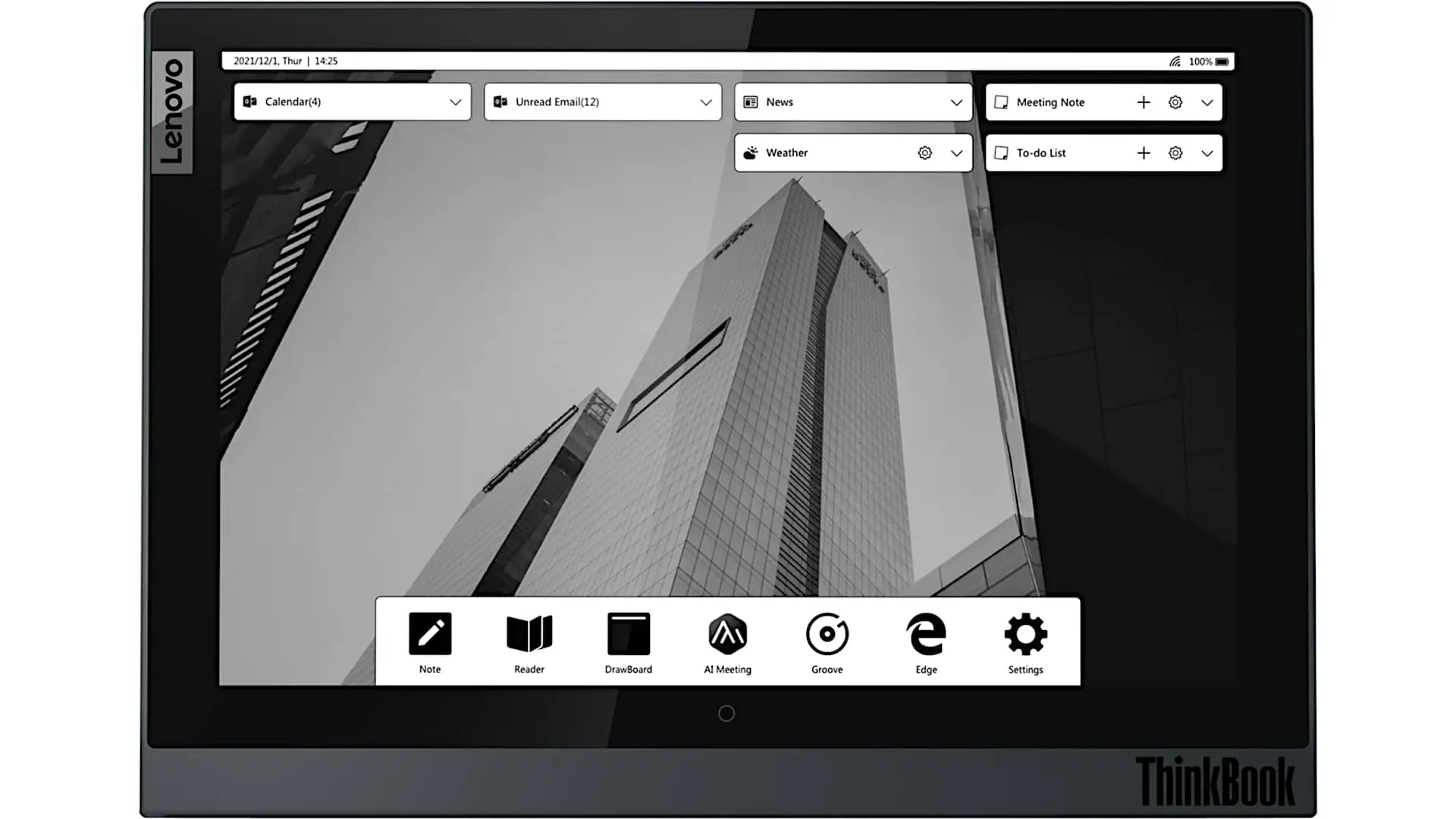
In this review, we take a detailed look at the Lenovo ThinkBook Plus Gen 2, a premium ultrabook that stands out from virtually every other laptop on the market. Lenovo has never been afraid to experiment with unconventional ideas, and this second-generation ThinkBook Plus continues that tradition by combining a traditional laptop with a large E-Ink display built directly into the lid.
While most manufacturers focus on making laptops thinner or faster, Lenovo has chosen to create a device that offers a completely different way of working. The result is a lightweight aluminum ultrabook featuring modern Intel hardware, a sharp internal display, and a surprisingly practical secondary E-Ink screen.
Dual Displays: IPS Inside, E-Ink Outside
At first glance, the ThinkBook Plus Gen 2 looks like a sleek premium laptop. Open it up, and you’ll find a vibrant 13.3-inch QHD+ IPS display with a 16:10 aspect ratio. However, the real surprise is found on the lid.
Covering most of the outer surface is a 12-inch E-Ink display with QHD+ resolution. Unlike the smaller 10-inch E-Ink panel used on the first-generation model, this larger screen feels far more practical and immersive.
Both displays support:
- Touch input
- Active pen support
- High-resolution viewing
- Note-taking capabilities
The E-Ink panel is protected by durable glass, making it sturdier than you might initially expect. While you’ll still want to treat it carefully, it doesn’t feel overly fragile during normal use.
Why Put an E-Ink Display on a Laptop Lid?
The concept behind the E-Ink screen is fairly straightforward: provide a low-power workspace that can remain useful even when the laptop lid is closed.
When closing the notebook, Lenovo’s software offers several options:
- Put the laptop to sleep
- Hibernate the system
- Power it off
- Continue using the E-Ink display
This allows users to interact with notes, documents, e-books, and other content while consuming dramatically less power than the primary IPS display.
For users who spend a lot of time reading or taking handwritten notes, the battery savings can be significant. Instead of measuring battery life in hours, E-Ink usage can potentially extend operation for well over a day before requiring a recharge.
Lenovo’s Customized E-Ink Software Experience
Lenovo has developed dedicated software specifically for the E-Ink display.
A physical button located on the lid launches a customized interface that acts as a quick-access dashboard. Users can customize shortcuts and launch frequently used applications directly from the E-Ink screen.
The launcher includes:
- Microsoft Office applications
- Weather widgets
- Lenovo note-taking software
- E-book reader functionality
- Productivity shortcuts
Applications can be added or removed based on individual preferences. For example, Microsoft OneNote isn’t included by default, but it can easily be added.
Note-Taking and Productivity Features
One of the most useful applications of the E-Ink display is handwritten note-taking.
Lenovo’s built-in Notes application is optimized for the screen and offers several useful features:
- Handwritten notes
- Shape correction
- Object insertion
- Exporting to OneNote
- Faster E-Ink pen response
Because the software is specifically designed for E-Ink technology, pen input feels more responsive than many third-party applications.
For students, researchers, and business users who regularly annotate documents, the large E-Ink screen provides a comfortable writing experience.
E-Book Reading and PDF Annotation
Another area where the E-Ink display excels is reading.
Lenovo includes its own e-book reader application capable of opening EPUB files and supporting document annotations. Users can view content in either single-page or dual-page layouts.
This makes the ThinkBook Plus particularly useful for:
- Reading technical documents
- Reviewing PDFs
- Annotating research papers
- Reading e-books
- Marking up business reports
The larger screen provides significantly more workspace than most dedicated e-readers.
An Unusual Wacom Tablet Mode
One of the more unusual features is the ability to transform the E-Ink display into a drawing tablet similar to a traditional Wacom device.
When connected to an external monitor, users can write directly on the E-Ink panel while viewing content on the external display.
While this functionality is interesting, it will likely appeal to a relatively small group of users compared to the note-taking and reading features.
The Drawbacks of E-Ink Technology
As innovative as the concept is, E-Ink technology still has limitations.
The biggest issue is refresh speed. Writing and drawing feel noticeably slower than on traditional LCD or OLED displays.
In applications that aren’t optimized for E-Ink, users may experience:
- Input lag
- Delayed handwriting rendering
- Slow scrolling
- Visible refresh transitions
Although Windows can technically run on the E-Ink display, the experience isn’t ideal for everyday browsing or general desktop usage.
Another limitation is the lack of built-in front lighting. Unlike many modern e-readers, the ThinkBook Plus Gen 2’s E-Ink screen does not include integrated illumination.
As a result, it works best in well-lit environments and is less suitable for reading in dark rooms or at night.
Pricing and Value
Despite its unique design, the ThinkBook Plus Gen 2 isn’t as expensive as many people might expect.
Typical configurations include:
- Core i5 model starting around $1,250
- Core i7 model around $1,340
Considering the premium aluminum construction, high-resolution displays, Intel Iris Xe graphics, 16GB of memory, and 512GB SSD storage, the pricing remains competitive with many premium ultrabooks.
The E-Ink display adds surprisingly little to the overall cost.
Design and Portability
The ThinkBook Plus Gen 2 remains an impressively portable machine.
At approximately:
- 2.55 pounds (1.16 kg)
- Extremely thin profile
It weighs about the same as many premium business ultrabooks, making it easy to carry throughout the day.
Despite housing two displays, Lenovo has managed to keep the overall design sleek and modern.
Display Quality
The internal QHD+ IPS display offers an excellent viewing experience.
Specifications include:
- 2560 × 1600 resolution
- 16:10 aspect ratio
- Nearly 400 nits brightness
- Full sRGB color coverage
- Above-average contrast
Brightness measurements reached approximately 397 nits, very close to Lenovo’s 400-nit claim.
While it doesn’t offer wide-gamut Adobe RGB or full DCI-P3 coverage, it delivers more than enough color accuracy for everyday productivity, media consumption, and light creative work.
Webcam, Security, and Audio
The laptop includes a 720p webcam positioned in a slightly raised top bezel.
Additional features include:
- Privacy shutter
- Four far-field microphones
- Fingerprint scanner integrated into the power button
- Alexa support
There is no Windows Hello IR camera, but the fingerprint reader provides quick and secure logins.
Keyboard and Trackpad
The keyboard is one area where the ThinkBook Plus differs significantly from Lenovo’s ThinkPad lineup.
While functional, the keyboard offers:
- Very shallow key travel
- Soft feedback
- Less tactile response
Users accustomed to ThinkPad keyboards may find it less satisfying for extended typing sessions.
The touchpad, however, performs much better. It uses Microsoft’s Precision drivers and delivers smooth, accurate tracking with reliable gesture support.
Performance and Hardware
The reviewed model features an Intel 11th-generation Core i7 processor.
Other specifications include:
- Intel Iris Xe graphics
- 16GB LPDDR4X RAM
- PCIe Gen 4 SSD support
- Intel Wi-Fi 6
- Bluetooth connectivity
Performance is exactly what you’d expect from a premium ultrabook. Everyday tasks, office work, multitasking, web browsing, and media consumption all run smoothly.
The Core i5 version should perform similarly for most users, making it a sensible option for those looking to save some money.
Upgradeability and Internal Layout
Accessing the internals requires removing Torx T5 screws and carefully releasing several tight clips around the chassis.
Inside you’ll find:
- 53Wh battery
- Single cooling fan
- One M.2 SSD slot
- Intel AX201 Wi-Fi 6 module (soldered)
- Dual-channel LPDDR4X memory (soldered)
Storage can be upgraded, but the memory cannot.
The included stylus stores neatly inside the chassis and recharges automatically when docked.
Stylus Performance
The bundled pen uses Wacom AES technology and offers:
- 4,096 pressure levels
- Two programmable buttons
- Rechargeable design
- Built-in storage silo
The pen works well for note-taking and annotation, although artists may notice some line jitter during detailed drawing work. It is more productivity-focused than art-focused.
Speakers, Thermals, and Battery Life
Audio quality is surprisingly strong for such a compact laptop.
The system features:
- Dual 2-watt Harman Kardon speakers
- Dolby Atmos support
- Good volume levels
- Decent bass response
- Clear dialogue reproduction
Cooling is equally impressive. Even under heavy workloads, fan noise remains relatively quiet and surface temperatures stay comfortable.
Battery life is respectable, though not class-leading.
With brightness set around 200 nits and a typical mix of productivity tasks, video streaming, and light photo editing, users can expect roughly:
- 7 to 8 hours of real-world battery life
The E-Ink display itself consumes very little power and does not significantly impact overall battery performance.
Final Verdict
The Lenovo ThinkBook Plus Gen 2 is one of the most innovative laptops currently available. Lenovo has refined the concept considerably compared to the first-generation model, introducing a larger E-Ink display, a better internal screen, improved software, and a more polished overall experience.
Its biggest strengths include:
- Large 12-inch E-Ink display
- Excellent QHD+ internal display
- Lightweight aluminum design
- Strong audio quality
- Useful note-taking features
- Competitive pricing
The E-Ink display won’t appeal to everyone, and its slow refresh rates remain an unavoidable limitation of the technology. However, for users who frequently read, annotate documents, or take handwritten notes, it offers genuine advantages that traditional laptops simply cannot match.
For those who can benefit from its unique dual-screen design, the ThinkBook Plus Gen 2 delivers a surprisingly practical and affordable take on a very unconventional idea.
Lenovo ThinkBook Plus (Gen 2)
-
Performance - 95%95%
-
Price - 94%94%
-
Value - 95%95%