
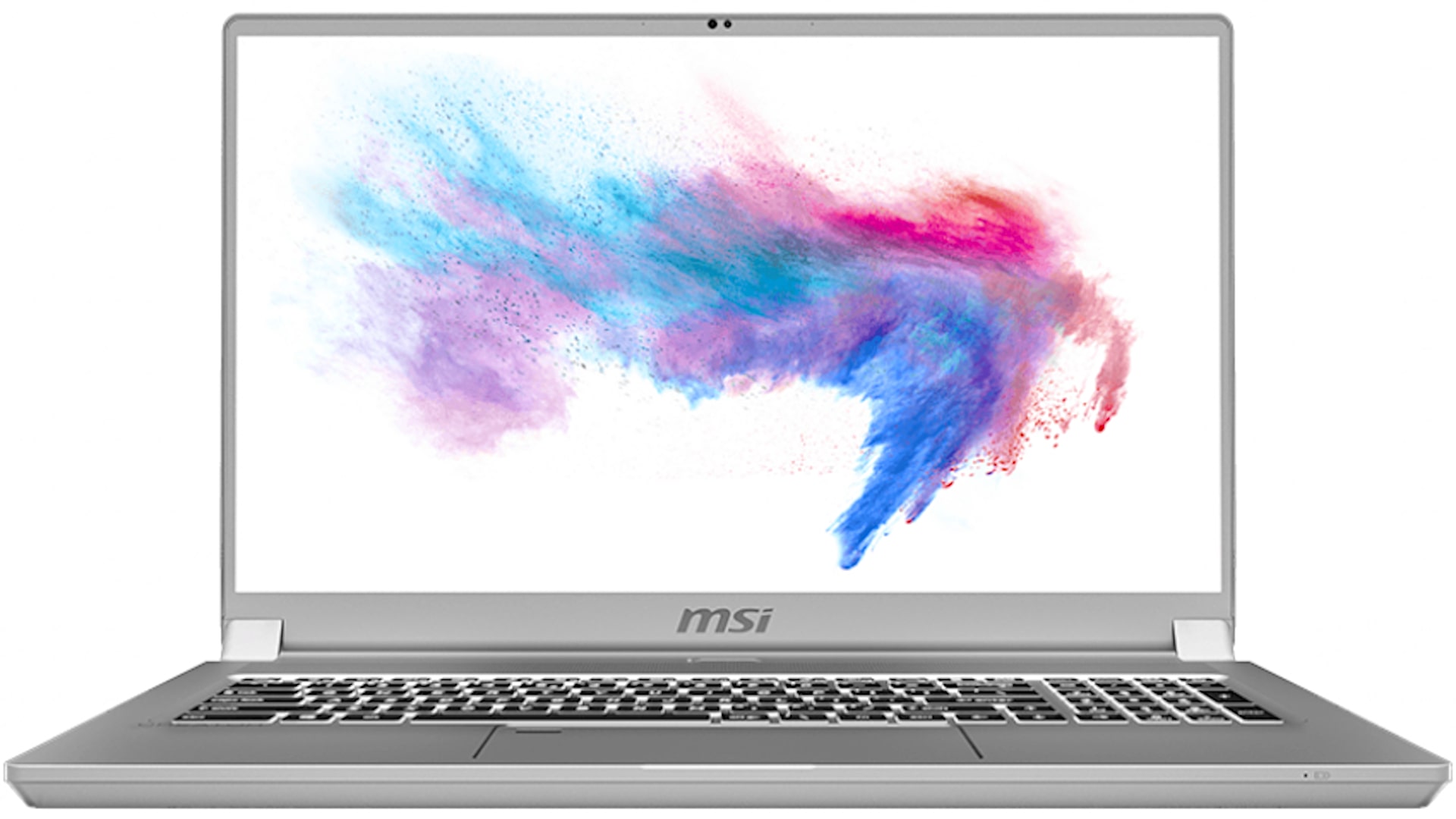
MSI has built its reputation primarily on gaming laptops, but the company has quietly been producing mobile workstations aimed at creative professionals for some time. The Creator 17 makes its lineage immediately obvious to anyone familiar with MSI’s GE75 Raider. The family resemblance is unmistakable, and that is not an accident. The Creator 17 is essentially a refined version of that 17-inch gaming machine, stripped of its aggressive aesthetic in favour of a more subdued silver finish, no red accents, and a white backlit keyboard instead of a full RGB light show.
A Gaming DNA With a Creative Makeover
What truly sets the Creator 17 apart from both its gaming sibling and the broader laptop market is its 4K mini LED display, one of the first of its kind to appear in a laptop. That technology alone has generated considerable excitement, and it goes a long way toward justifying the Creator 17’s positioning as a premium creative tool.
Following a Familiar Industry Playbook
MSI is not alone in repurposing gaming hardware for creative professionals. Razer and ASUS have pursued the same strategy, and the approach makes a great deal of sense. The engineering already exists to produce thin, powerful 17-inch chassis with capable cooling, and swapping the styling for something more office-appropriate opens up an entirely different buyer demographic.
Where some manufacturers also swap out consumer GeForce graphics for professional Nvidia Quadro cards, MSI keeps GeForce RTX inside the Creator 17. For the majority of content creators working at home or in small studios, this is a perfectly sensible choice. GeForce RTX graphics handle 4K video editing, rendering, and even compositing without breaking a sweat. Quadro cards serve a more specialised corporate purpose, relevant to large studios and enterprise environments rather than independent creators or enthusiasts.
Display Options and the Mini LED Panel
MSI offers the Creator 17 in multiple display configurations to suit different buyers. The entry point is a Full HD panel running at 144Hz with 300 nits of brightness, clearly aimed at users who want capable hardware for creative work but still want the option to game without the RGB aesthetics. A step up brings a 4K IPS panel covering the full Adobe RGB colour space, targeting photographers and video editors who need accurate colour representation. At the top of the range sits the mini LED 4K display that is the headline feature of this review unit.
The mini LED panel claims full DCI P3 colour coverage and a peak brightness of 1,000 nits. It also incorporates 240 local dimming zones, a technology borrowed from the premium television market, which selectively reduces brightness in darker areas of the image to enhance perceived contrast.
In practice, measuring the panel with a colorimeter reveals some complications. MSI’s colour management software offers five presets including sRGB, two variations of P3, and Adobe RGB, but none of them measure as truly colour accurate. The default P3 profile reads more like an Adobe RGB profile to the eye. Brightness peaks at close to 900 nits rather than the advertised 1,000, which is still extraordinary for a laptop display. However, the black levels are considerably higher than those of an OLED panel or a high-quality IPS screen, which means the impressive brightness contrast ratio does not fully translate into deep, inky blacks in dark scenes.
For professional colour work, the recommendation would be to use a personal colorimeter to calibrate the display from scratch rather than relying on the built-in presets. Windows HDR mode is technically an option but remains an inconsistent experience that tends to distort colours and requires considerable effort to correct. For casual use, the display is genuinely attractive. Colours appear vivid and punchy, and the sheer brightness of the panel gives content a sense of depth and vibrancy that more modest screens simply cannot match.
Performance Specifications and Real-World Results
Every configuration of the Creator 17 is built around an eight-core Intel 10th Generation Core i7 processor. GPU options scale from an RTX 2060 at the base level through an RTX 2070 Max-Q and RTX 2070 Super Max-Q, up to the flagship RTX 2080 Super Max-Q in the top configuration reviewed here. Pricing spans from approximately $1,799 at the entry level to $3,599 for the fully equipped model.
The top-end variant pairs its RTX 2080 Super Max-Q with 32GB of DDR4 memory running at 2,666MHz, housed across two RAM slots that support a maximum of 64GB. Storage comes by way of a fast M.2 NVMe SSD, with a second M.2 slot available for expansion using either NVMe or SATA drives.
Performance in creative applications is strong. Running 4K video exports in Adobe Premiere caused no observable thermal throttling, and Blender renders completed without issue. The machine handles demanding creative workloads with confidence. That said, the Creator 17 is not tuned for sustained gaming the way a purpose-built gaming laptop is. Users who plan to run graphically demanding games at maximum settings may encounter thermal constraints that limit peak GPU performance. For that use case, the GE75 Raider would be the better choice, offering greater thermal headroom. For creative professionals, however, the Creator 17 handles everything it was designed for with composure.
Portability and Build Quality
For a 17-inch machine with this level of specification, the Creator 17 is genuinely portable. It weighs 5.29 pounds (2.4 kilograms) and measures under an inch in thickness, which is a notable achievement for its size class. The entire chassis is constructed from aluminium, top and bottom, giving it a premium feel and solid structural rigidity without adding unnecessary bulk.
The included power brick delivers 230 watts and is relatively compact for its output class, a welcome detail when packing a bag for travel. The laptop also supports charging via USB-C, though at a maximum of 100 watts through that interface, it supplements rather than replaces the main charger.
Connectivity
Port selection on the Creator 17 is well considered. A Thunderbolt 3 port provides high-speed external display and data connectivity, while the USB-C port adds charging flexibility. Standard USB-A ports are included alongside both a headphone and microphone jack, with the latter supporting high-resolution audio, a thoughtful inclusion for audio-focused creators. The microSD card slot operates at UHS Speed Class 3, offering fast transfer speeds for camera cards. Ethernet and HDMI 2.0 round out the selection, with the HDMI output supporting 4K output at 60Hz.
One minor ergonomic concern is port placement. The connections are grouped toward the middle sections of both sides, which may occasionally interfere with an external mouse depending on individual setups. The power connector sits in a similar zone but is angled, which reduces the likelihood of cable interference.
Keyboard, Trackpad, and Speakers
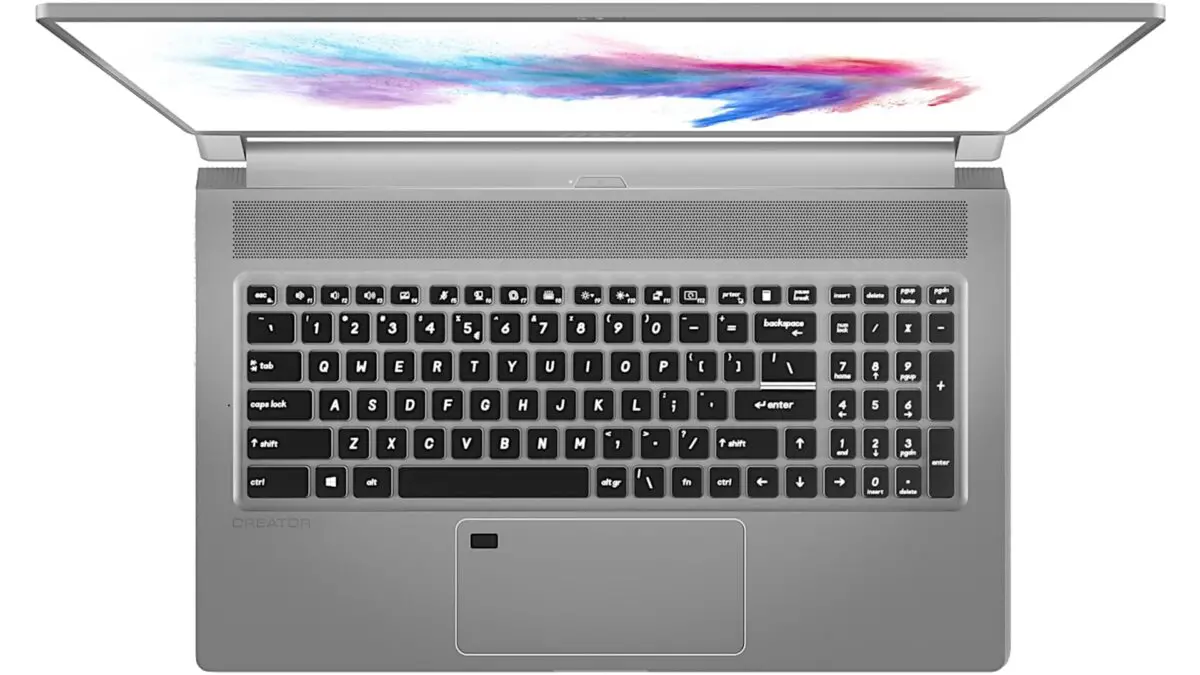
The keyboard on the Creator 17 is pleasant to use and bears close similarity to the one found on the GE75 Raider. Key feel is crisp, though slightly less springy than the gaming model. The white backlighting is offered in multiple brightness stages, and the absence of RGB colour cycling suits the professional aesthetic of the machine. The large glass trackpad is smooth and responsive, with accurate tracking and a refined surface texture that feels comfortable during extended use.
The speaker system consists of two two-watt drivers and delivers an average result. Audio is acceptable for everyday media consumption but does not distinguish itself in any particular way. Content creators who care about sound quality will want to reach for headphones or external speakers.
Battery Life and Graphics Switching
The Creator 17 uses an 82Wh battery, comparable in capacity to the Razer Blade 15. Battery life is heavily dependent on display choice and workload. The mini LED panel at high brightness settings will consume power quickly, and users who frequently push it toward its peak luminance should expect shorter run times. In mixed productivity testing at 150 nits, covering typical tasks such as word processing, spreadsheets, and video streaming, the machine returned roughly four and a half hours.
The laptop features Nvidia Optimus for automatic graphics switching, allowing it to fall back on integrated Intel graphics during lighter tasks to conserve battery. MSI’s Creator Centre software, a restyled version of the Dragon Centre application from their gaming lineup, also allows users to manually lock the system to dedicated graphics only, which can yield a performance improvement in certain scenarios. It is worth noting that the built-in displays do not support G-Sync, so that benefit is absent even in dedicated GPU mode.
Upgradeability and Internal Layout
Removing the bottom cover requires backing out 15 Phillips head screws, one of which is concealed beneath a factory seal sticker. Once the cover is off, access is relatively straightforward, starting from the front edge with gentle prying. Inside, the layout reveals two M.2 slots, the battery, and the Wi-Fi 6 card (Intel AX201), all of which are accessible without major disassembly.
The cooling system uses MSI’s Cooler Boost Trinity Plus configuration, which employs three fans total, two cooling the GPU and one dedicated to the CPU, connected by seven heat pipes. Intake and exhaust vents are positioned at the rear and sides, a layout borrowed directly from MSI’s gaming laptops and well suited to sustained thermal performance.
One notable aspect of the internal design is the inverted motherboard layout, also seen in MSI’s Stealth series. This means the heatsinks for the CPU and GPU face upward toward the keyboard, and accessing them for maintenance or replacement requires removing the motherboard entirely. During use, the keyboard surface becomes warm but remains tolerable. The underside, particularly toward the centre where the most heat is generated, does get quite hot under sustained heavy loads. Lap use during intensive tasks like 3D rendering is not comfortable, though everyday productivity and content consumption are fine.
Final Thoughts
The MSI Creator 17 is a capable and well-built machine that succeeds at what it sets out to do. For creative professionals who want a powerful 17-inch laptop without the gaming aesthetics, it delivers strong performance in Adobe Premiere, Blender, and similar applications, along with a premium aluminium build, fast storage, and flexible connectivity.
The mini LED display is the centrepiece of this configuration, and it is a genuinely impressive piece of technology in terms of raw brightness and colour vibrancy. It falls short of its full potential, however, due to factory colour calibration profiles that do not measure as accurately as they should, and black levels that cannot compete with OLED or premium IPS panels. For professionals who rely on display accuracy, personal calibration is strongly recommended.
The laptop’s performance envelope is optimised for creative workloads rather than gaming, and buyers prioritising gaming performance would be better served by the GE75 Raider. For everyone else who wants a well-rounded creative workstation in a portable 17-inch form factor, the Creator 17 is a strong option, and its mini LED technology offers a compelling glimpse at what future laptop displays may look like as the technology matures.
MSI Creator 17
-
Performance - 96%96%
-
Price - 96%96%
-
Value - 96%96%