
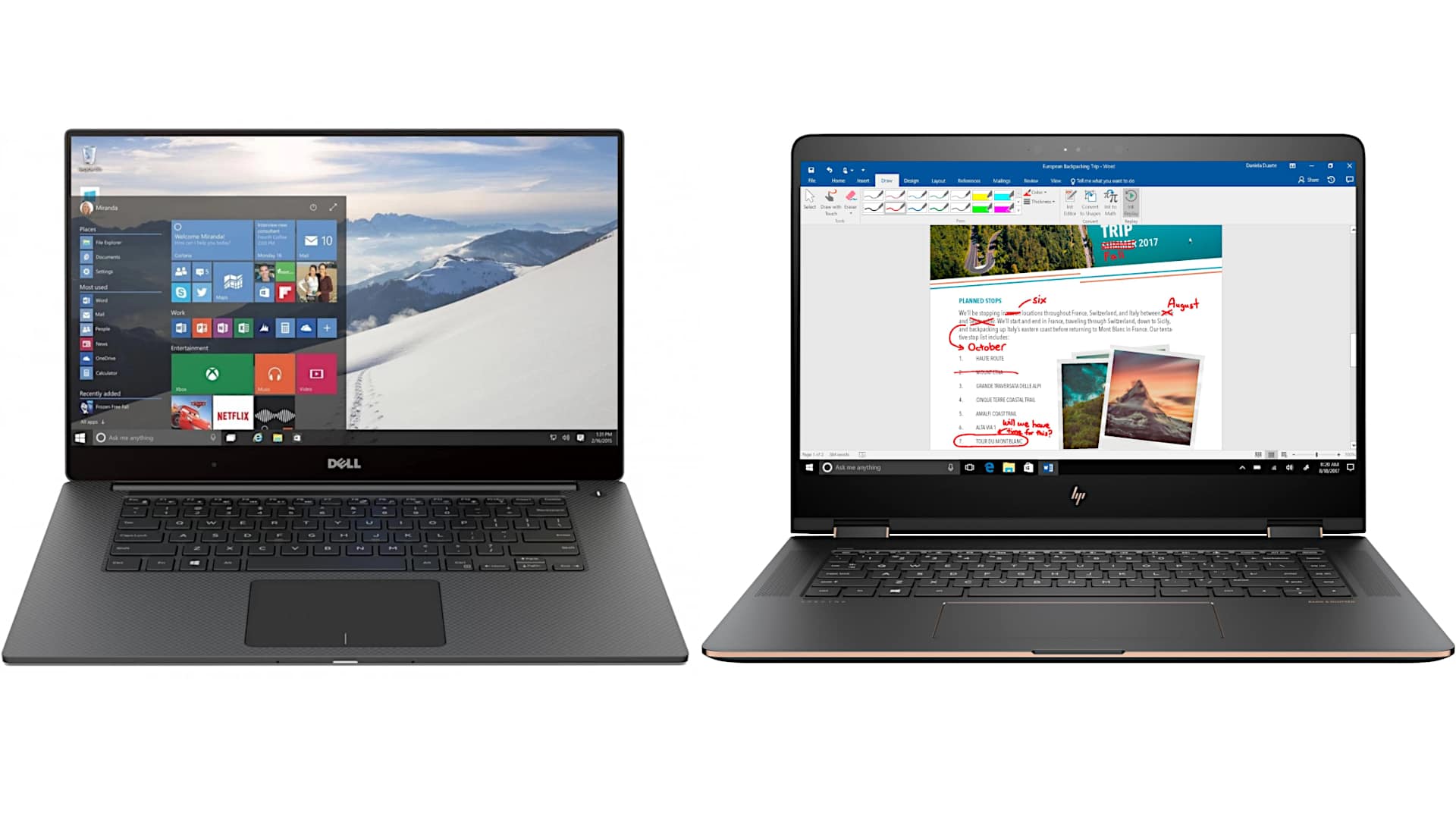
The Dell XPS 15 9560 and HP Spectre x360 15 are premium 15-inch Windows 10 laptops equipped with Intel Core i7 processors and high-resolution displays. Both models feature 4K screens, although Dell also offers a Full HD option for users who prioritize battery life.
Design and Build Quality
Despite their different designs and hardware configurations, both laptops weigh approximately 4.4 pounds (around 2 kilograms) and have similarly slim profiles. This is particularly impressive because the Dell houses a powerful quad-core processor and dedicated graphics, while the HP is a convertible laptop with a complex 360-degree hinge mechanism.
Both machines feature sturdy metal chassis with excellent build quality and virtually no flex. The XPS 15 has a more understated, performance-focused appearance with its carbon-fiber interior, while the Spectre x360 embraces a more stylish and luxurious aesthetic with its angular design and polished accents. Choosing between them largely comes down to personal taste.
Keyboard, Touchpad, and Audio
Both laptops include backlit keyboards and large touchpads, although neither offers a dedicated numeric keypad.
The Dell uses a Microsoft Precision touchpad, while HP opts for a Synaptics touchpad. The Spectre’s touchpad feels smoother and more MacBook-like, offering additional customization options. The Dell’s touchpad is accurate but feels slightly slower and stickier in comparison.
Although both keyboards provide roughly 1.3mm of key travel, they deliver very different typing experiences. HP has done an excellent job making a shallow-travel keyboard feel comfortable and responsive. The Dell keyboard is functional but feels firmer and somewhat harsher during extended typing sessions.
For biometric authentication, Dell includes a fingerprint reader compatible with Windows Hello, while HP relies on facial recognition through its webcam.
Audio quality favors the HP. Its Bang & Olufsen-tuned speakers are positioned above the keyboard, directing sound toward the user. The Dell’s downward-firing speakers are decent but cannot match the Spectre’s richer multimedia experience.
Traditional Laptop vs Convertible Flexibility
One of the biggest differences between these devices is their form factor.
The Dell XPS 15 is a conventional clamshell laptop. The 4K version supports touch input, but it lacks active pen functionality.
The HP Spectre x360, on the other hand, is a fully convertible device that can be used in laptop, tent, presentation, or tablet modes. It includes active pen support, making it an excellent choice for artists, designers, note-takers, and anyone who values touchscreen versatility.
Users interested in digital drawing or handwriting will find the Spectre significantly more appealing.
Processor and Graphics Performance
Although both systems carry Core i7 branding, they target very different performance levels.
The Dell XPS 15 features a 45-watt quad-core processor paired with NVIDIA GTX 1050 graphics. The HP Spectre x360 uses a lower-power 15-watt dual-core Core i7 and NVIDIA 940MX graphics.
For everyday tasks such as web browsing, streaming 4K video, Microsoft Office work, and general productivity, both laptops feel equally responsive.
However, the Dell’s extra CPU cores make a noticeable difference in demanding workloads such as:
- Large Excel calculations
- Software development
- Video editing
- CAD applications
- Scientific analysis
- Professional content creation
In heavily threaded applications, the Dell can be nearly twice as fast.
Gaming Capabilities
Neither laptop is designed primarily for gaming, but the Dell clearly holds the advantage.
The GTX 1050 inside the XPS 15 offers significantly more graphics power than the 940MX found in the Spectre. This allows the Dell to run many modern games at playable settings, while the HP is better suited for older or less demanding titles.
The Spectre handles casual gaming comfortably, but users interested in newer AAA titles will have a much better experience on the XPS 15.
Display Quality
Both laptops feature 15.6-inch displays, but Dell offers more options.
The XPS 15 can be configured with either:
- Full HD matte IPS display
- 4K Sharp IGZO touchscreen
The Spectre x360 comes exclusively with a 4K touchscreen that supports active pen input.
Color reproduction is excellent on both machines. The HP covers the full sRGB color space and approximately 75% of Adobe RGB, making it a strong choice for creative work.
The Dell’s 4K panel goes even further, covering nearly 99% of Adobe RGB. This wider color gamut makes it particularly attractive for photographers, graphic designers, and print professionals.
For users working primarily with web content, both displays are excellent. For professional print workflows, Dell’s panel offers a clear advantage.
Brightness and Image Quality
Testing showed very similar display performance:
| Specification | HP Spectre x360 | Dell XPS 15 |
|---|---|---|
| Brightness | 323 nits | 305 nits |
| Contrast Ratio | 740:1 | 680:1 |
| Black Level | 0.41 | 0.45 |
Both screens exhibit minimal light bleed and provide excellent viewing experiences.
Thunderbolt 3 and Connectivity
Both laptops include Thunderbolt 3 connectivity, opening the door to:
- Docking stations
- High-speed storage
- Multiple displays
- External GPU solutions
Each system uses a two-lane Thunderbolt 3 implementation rather than the faster four-lane version found in some premium laptops. For most users, this limitation is unlikely to be noticeable.
The HP also includes an additional USB-C 3.1 port alongside Thunderbolt.
Another difference is HDMI support:
- HP offers HDMI 2.0
- Dell includes HDMI 1.4
This matters primarily for users connecting 4K displays at 60Hz.
Memory and Storage
Both systems are available with:
- 8GB or 16GB of RAM
- Two upgradeable memory slots
- M.2 PCIe NVMe SSDs
Theoretical maximum memory capacity reaches 32GB on both machines.
Storage performance is excellent. In testing, the HP’s SSD slightly outperformed the Dell’s SSD, although both provide fast boot times and responsive performance.
Pricing Differences
The HP Spectre x360 configuration reviewed costs approximately $1,499.
An equivalently equipped Dell XPS 15 generally falls between $1,800 and $2,000 depending on configuration.
The price premium reflects the Dell’s stronger processor and graphics capabilities. Buyers should determine whether they truly need the additional performance before spending extra money.
Battery Life
Battery life varies depending on configuration.
The Dell is available with either:
- 56Wh battery
- 97Wh battery
The HP includes a 79Wh battery.
Even with Dell’s larger battery option, the Spectre generally lasts longer due to its lower-power processor and graphics hardware.
Typical battery life estimates:
HP Spectre x360
- 10+ hours of productivity
- 9–10 hours of Photoshop work
Dell XPS 15
- 8–10 hours for light tasks
- 7–8 hours for creative applications
The HP is the battery life champion in this comparison.
Heat and Noise
The Spectre x360 remains cooler and quieter during normal use thanks to its low-power hardware. Fans rarely become noticeable unless performing demanding tasks.
The XPS 15 runs warmer and activates its cooling system more frequently, especially during intensive workloads such as Photoshop, video editing, or gaming. Fan noise remains reasonable but is more noticeable than on the HP.
Final Verdict
Although these laptops share similar sizes, weights, and premium construction, they target different users.
Choose the Dell XPS 15 9560 if you need:
- Maximum processing power
- Dedicated GTX 1050 graphics
- Better gaming performance
- Faster video editing
- Professional creative workloads
- Wider Adobe RGB color coverage
Choose the HP Spectre x360 15 if you want:
- Convertible flexibility
- Active pen support
- Better speakers
- Longer battery life
- Cooler and quieter operation
- A more versatile multimedia experience
The XPS 15 is the better choice for power users and content creators, while the Spectre x360 excels as a premium all-purpose convertible for productivity, entertainment, and digital art.